Musa (genus): Difference between revisions
CSV import |
CSV import Tags: mobile edit mobile web edit |
||
| Line 47: | Line 47: | ||
[[Category:Flora of Southeast Asia]] | [[Category:Flora of Southeast Asia]] | ||
[[Category:Flora of the Pacific]] | [[Category:Flora of the Pacific]] | ||
<gallery> | |||
File:Starr 050826-4195 Musa sp..jpg|Starr 050826-4195 Musa sp. | |||
File:Food served on Banana Leaf.jpg|Food served on Banana Leaf | |||
File:Musa JPG01.jpg|Musa JPG01 | |||
File:Banana flowers.JPG|Banana flowers | |||
File:Musa acuminata1.jpg|Musa acuminata1 | |||
File:Banana Cotswold Wildlife Park.JPG|Banana Cotswold Wildlife Park | |||
File:Musa ornata Roxburgh - flower view 01.jpg|Musa ornata Roxburgh - flower view 01 | |||
File:Musa velutina1.jpg|Musa velutina1 | |||
File:Musavar.jpg|Musavar | |||
File:M. splendida A.Chev.jpg|M. splendida A.Chev | |||
</gallery> | |||
Latest revision as of 05:59, 3 March 2025
Musa (genus)[edit]
The Musa is a genus of perennial flowering plants in the family Musaceae. It is one of three genera in the family, the others being Ensete and Musella. The genus is native to the tropical regions of Southeast Asia and the South Pacific.
Description[edit]
The Musa genus includes large herbaceous plants with a pseudostem made up of tightly packed leaf sheaths. The leaves are large and oblong, while the flowers are produced in a large, hanging, cylindrical inflorescence. The fruit, commonly known as a banana or plantain, is a berry and can come in a variety of sizes, colors, and firmness.
Species[edit]
There are around 70 species of Musa, including Musa acuminata, Musa balbisiana, and Musa paradisiaca. These species are known for their economic importance as the primary producers of bananas and plantains.
Cultivation and uses[edit]
Musa species are cultivated for their fruit and fiber, and to a lesser extent for ornamental purposes. The fruit is a staple food in many tropical countries and is also used in cooking. The fiber is used in the production of textiles and paper.
Propagation[edit]
Musa plants are usually propagated by pups or suckers that grow from the base of the parent plant. They can also be propagated by seeds, although this is less common due to the long germination period and the variability of the offspring.
Diseases and pests[edit]
Musa plants are susceptible to a number of diseases and pests, including the banana bunchy top virus, banana bacterial wilt, and the banana weevil. These can cause significant damage to crops and are a major concern for commercial growers.
Conservation[edit]
Many species of Musa are threatened by habitat loss and over-exploitation. Conservation efforts are focused on preserving the genetic diversity of the genus through in situ and ex situ conservation methods.
See also[edit]
References[edit]
<references />
External links[edit]
-
 Starr 050826-4195 Musa sp.
 -
 Food served on Banana Leaf
 -
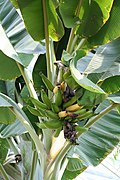 Musa JPG01
 -
 Banana flowers
 -
 Musa acuminata1
 -
 Banana Cotswold Wildlife Park
 -
 Musa ornata Roxburgh - flower view 01
 -
 Musa velutina1
 -
 Musavar
 -
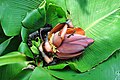 M. splendida A.Chev


