Blanc chloromethylation: Difference between revisions
CSV import Tags: mobile edit mobile web edit |
CSV import Tags: mobile edit mobile web edit |
||
| Line 32: | Line 32: | ||
[[Category:Chemical processes]] | [[Category:Chemical processes]] | ||
{{Chemistry-stub}} | {{Chemistry-stub}} | ||
== Blanc chloromethylation gallery == | |||
<gallery> | |||
File:Blanc Chloromethylation Reaction Scheme.png|Blanc Chloromethylation Reaction Scheme | |||
File:ChloromethylationMechanism.png|Chloromethylation Mechanism | |||
</gallery> | |||
Latest revision as of 05:57, 3 March 2025
Blanc chloromethylation is a chemical reaction that involves the introduction of a chloromethyl group into an aromatic compound. This reaction is named after the French chemist Gustave Louis Blanc, who first reported it in 1923. The Blanc chloromethylation has been widely used in the synthesis of intermediates for pharmaceuticals, agrochemicals, and other organic compounds.
Overview[edit]
The Blanc chloromethylation reaction typically involves the reaction of an aromatic compound with formaldehyde and hydrogen chloride, often in the presence of a Lewis acid catalyst such as zinc chloride (ZnCl2). The general reaction scheme can be represented as follows:
Ar-H + CH2O + HCl → Ar-CH2Cl + H2O
where Ar-H represents the aromatic compound.
Mechanism[edit]
The mechanism of the Blanc chloromethylation involves several key steps. Initially, the Lewis acid catalyst activates the formaldehyde, making it more reactive. Subsequently, the activated formaldehyde reacts with the aromatic compound to form an intermediate. This intermediate then reacts with hydrogen chloride to produce the chloromethylated aromatic compound and water as a byproduct.
Applications[edit]
Blanc chloromethylation has found applications in various fields of chemistry due to its ability to introduce chloromethyl groups into aromatic compounds efficiently. Some of the key applications include:
- Synthesis of pharmaceuticals: Many pharmaceutical compounds contain chloromethyl groups, and the Blanc chloromethylation provides a straightforward route to these structures.
- Agrochemical production: Similar to pharmaceuticals, many agrochemicals require the introduction of chloromethyl groups into aromatic rings, which can be achieved through this reaction.
- Preparation of polymers: Chloromethylated aromatic compounds can serve as precursors to certain polymers, making this reaction valuable in polymer chemistry.
Safety and Environmental Considerations[edit]
The use of hydrogen chloride and formaldehyde, both of which are hazardous chemicals, requires careful handling and appropriate safety measures. Additionally, the generation of waste products and the use of Lewis acid catalysts necessitate considerations for environmental impact and disposal.
See Also[edit]
References[edit]
<references/>

Blanc chloromethylation gallery[edit]
-
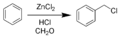 Blanc Chloromethylation Reaction Scheme
 -
 Chloromethylation Mechanism


