Cronartium ribicola: Difference between revisions
CSV import Tags: mobile edit mobile web edit |
CSV import |
||
| Line 22: | Line 22: | ||
{{fungus-stub}} | {{fungus-stub}} | ||
{{plant-disease-stub}} | {{plant-disease-stub}} | ||
== Cronartium ribicola gallery == | |||
<gallery> | |||
File:Cronartium ribicola1.jpg|Cronartium ribicola1 | |||
File:Cronartium ribicola on Pinus strobus abrimaal2013.jpg|Cronartium ribicola on Pinus strobus abrimaal2013 | |||
File:Cronartium ribicola2.jpg|Cronartium ribicola2 | |||
File:Cronartium ribicola Pinus (08).jpg|Cronartium ribicola Pinus (08) | |||
File:Seedlings at Dorena Genetic Resource Center, Umpqua National Forest (24878686917).jpg|Seedlings at Dorena Genetic Resource Center, Umpqua National Forest | |||
</gallery> | |||
Latest revision as of 05:51, 3 March 2025
Cronartium ribicola is a species of fungus in the family Cronartiaceae. It is most well-known as the causative agent of white pine blister rust, a disease that has caused significant damage to white pine populations in North America.
Taxonomy[edit]
The species was first described scientifically by J.C. Arthur in 1906. The genus name Cronartium comes from the Greek kronos (time) and artium (parts), referring to the long period of time the fungus spends in its aecial stage. The species name ribicola refers to its association with plants in the genus Ribes.
Life cycle[edit]
The life cycle of Cronartium ribicola is complex and involves two different host plants. The primary host is a species of white pine, while the secondary host is a plant in the genus Ribes (currants and gooseberries). The fungus produces five different types of spores over the course of its life cycle, which are spread by wind and rain.
Disease symptoms and management[edit]
Infection by Cronartium ribicola causes a disease known as white pine blister rust. Symptoms include cankers on the trunk and branches, and yellowing and wilting of needles. Management strategies include the removal of infected trees and the planting of resistant varieties.
Impact[edit]
White pine blister rust has had a significant impact on white pine populations in North America. It has also had economic impacts, as white pines are an important timber species.
See also[edit]


This article is a plant disease stub. You can help WikiMD by expanding it!
Cronartium ribicola gallery[edit]
-
 Cronartium ribicola1
 -
 Cronartium ribicola on Pinus strobus abrimaal2013
 -
 Cronartium ribicola2
 -
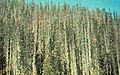 Cronartium ribicola Pinus (08)
 -
 Seedlings at Dorena Genetic Resource Center, Umpqua National Forest


.jpg)
.jpg)
