Black Country: Difference between revisions
CSV import |
CSV import |
||
| Line 35: | Line 35: | ||
{{UK-geo-stub}} | {{UK-geo-stub}} | ||
{{food-stub}} | {{food-stub}} | ||
<gallery> | |||
File:1911 Britannica - South Staffordshire.png|1911 Britannica - South Staffordshire | |||
File:The local government structure within the Black Country (Pre-1966).png|The local government structure within the Black Country (Pre-1966) | |||
File:Griffiths' Guide to the iron trade of Great Britain an elaborate review of the iron (and) coal trades for last year, addresses and names of all ironmasters, with a list of blast furnaces, iron (14763815742).jpg|Griffiths' Guide to the iron trade of Great Britain | |||
File:The Oak House.JPG|The Oak House | |||
File:Griffiths' Guide to the iron trade of Great Britain an elaborate review of the iron (and) coal trades for last year, addresses and names of all ironmasters, with a list of blast furnaces, iron (14761790294).jpg|Griffiths' Guide to the iron trade of Great Britain | |||
File:Snuffbox MET DP-13455-031.jpg|Snuffbox | |||
File:Griffiths' Guide to the iron trade of Great Britain an elaborate review of the iron (and) coal trades for last year, addresses and names of all ironmasters, with a list of blast furnaces, iron (14741151646).jpg|Griffiths' Guide to the iron trade of Great Britain | |||
File:Redhouseglasscone.jpg|Redhouse Glass Cone | |||
File:Chain Making 5 (3962358269).jpg|Chain Making | |||
File:Doultons Clay Pit - geograph.org.uk - 1093328.jpg|Doultons Clay Pit | |||
</gallery> | |||
Latest revision as of 05:49, 3 March 2025
Black Country is an area of the West Midlands in England, which includes parts of the counties of Staffordshire, Worcestershire, and Warwickshire. The region is known for its rich industrial heritage, with coal mines, steel mills, and iron foundries once being a major part of its economy.
History[edit]
The term "Black Country" is believed to have originated in the mid-19th century, referring to the black smoke from the many thousands of ironworking foundries and forges. Other theories mention the abundance of coal in the region - miners would come up from the pits covered in the black dust. The region was described as 'Black by day and red by night' by Elihu Burritt, the American Consul to Birmingham in 1862.
Geography[edit]
The Black Country has no agreed boundaries but to traditionalists is defined as "the area where the coal seam comes to the surface". This definition includes West Bromwich, Oldbury, Blackheath, Cradley Heath, Old Hill, Bilston, Dudley, Tipton, Wednesfield and parts of Halesowen, Wednesbury and Walsall but excludes Birmingham, Wolverhampton, Stourbridge and Smethwick.
Culture[edit]
The Black Country dialect is known as "Black Country Spake" and is a version of the early English language with Celtic influences. The region is also known for its unique culinary contribution, the Black Country Pudding, a type of pork and leek sausage.
Economy[edit]
The Black Country was one of the earliest heavily industrialized areas in the UK during the Industrial Revolution. The area still maintains a strong manufacturing sector, with a significant portion of the Black Country's economy consisting of large manufacturing businesses and SMEs.
Education[edit]
The University of Wolverhampton is the main provider of higher education in the area. There are also numerous primary and secondary schools, providing education to the residents of the Black Country.
Transport[edit]
The Black Country is served by a network of canals, including the Dudley Canal and the Walsall Canal, as well as by rail services such as the West Midlands Trains.
See also[edit]


-
 1911 Britannica - South Staffordshire
 -
 The local government structure within the Black Country (Pre-1966)
 -
 Griffiths' Guide to the iron trade of Great Britain
 -
 The Oak House
 -
 Griffiths' Guide to the iron trade of Great Britain
 -
 Snuffbox
 -
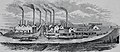 Griffiths' Guide to the iron trade of Great Britain
 -
 Redhouse Glass Cone
 -
 Chain Making
 -
 Doultons Clay Pit

.png)
_coal_trades_for_last_year,_addresses_and_names_of_all_ironmasters,_with_a_list_of_blast_furnaces,_iron_(14763815742).jpg)

_coal_trades_for_last_year,_addresses_and_names_of_all_ironmasters,_with_a_list_of_blast_furnaces,_iron_(14761790294).jpg)

_coal_trades_for_last_year,_addresses_and_names_of_all_ironmasters,_with_a_list_of_blast_furnaces,_iron_(14741151646).jpg)

.jpg)

