Shot noise: Difference between revisions
CSV import Tags: mobile edit mobile web edit |
CSV import |
||
| Line 37: | Line 37: | ||
{{Physics-stub}} | {{Physics-stub}} | ||
{{Electronics-stub}} | {{Electronics-stub}} | ||
== Shot noise gallery == | |||
<gallery> | |||
File:photon-noise.jpg|Photon noise | |||
File:Poisson pmf.svg|Poisson pmf | |||
</gallery> | |||
Latest revision as of 05:44, 3 March 2025
Shot noise is a type of noise that occurs when the finite number of particles (such as electrons, photons, or ions) that carry energy in a system is small enough that the fluctuations in their flow produce detectable variations in the signal. Shot noise is a fundamental property of all systems in which particles are discrete, and it is an important phenomenon in fields such as electronics, optics, and quantum mechanics. It is a form of random process that follows a Poisson distribution, indicative of its quantum mechanical origins.
Overview[edit]
Shot noise arises in virtually all electronic devices and optical systems where discrete charges or photons are transmitted. In electronics, it is often observed in semiconductor devices like diodes and transistors, where the discrete movement of electrons across a barrier or junction generates fluctuating electrical currents. Similarly, in optical systems, shot noise results from the discrete nature of light, manifesting as intensity fluctuations in a light beam composed of photons.
The magnitude of shot noise is proportional to the square root of the average number of particles (such as electrons or photons) transmitted per unit time, reflecting its Poisson statistics. This implies that while the noise increases with signal strength, its relative contribution decreases, making shot noise more significant in low-signal situations.
Mathematical Description[edit]
The power spectral density (PSD) of shot noise is given by the Schottky formula:
\[ PSD = 2qI \]
where \(q\) is the charge of the particle (e.g., the electron charge) and \(I\) is the average current. This formula indicates that the PSD of shot noise is constant across frequency, characterizing it as white noise.
Impact and Mitigation[edit]
In many applications, shot noise represents a fundamental limit to the detection sensitivity and signal-to-noise ratio (SNR). For instance, in electronic amplifiers, reducing shot noise is crucial for enhancing performance, especially in low-signal applications like radio astronomy or quantum computing. Techniques to mitigate shot noise include cooling electronic components to reduce thermal noise, thereby making shot noise more dominant and easier to analyze and filter.
Quantum Aspects[edit]
Shot noise is inherently related to the quantum nature of particles. It serves as evidence of the particle aspect of electrons and photons, in contrast to their wave nature. In quantum optics, shot noise is a manifestation of the quantum uncertainty principle, as measuring the number of photons in a light beam inevitably introduces fluctuations in the phase of the light wave.
Applications[edit]
Shot noise has applications in various scientific and technological fields. In metrology, it sets the ultimate limit on the precision of measurements. In quantum optics, it is used to generate true random numbers, crucial for cryptography. Shot noise is also a tool in surface science and spectroscopy for analyzing the properties of materials at the atomic or molecular level.
See Also[edit]
References[edit]
<references/>


Shot noise gallery[edit]
-
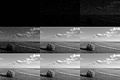 Photon noise
 -
 Poisson pmf


