RyhB: Difference between revisions
CSV import Tags: mobile edit mobile web edit |
CSV import |
||
| Line 24: | Line 24: | ||
{{RNA-stub}} | {{RNA-stub}} | ||
<gallery> | |||
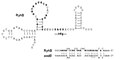
File:RyhB sodB.jpg|RyhB sodB | |||
</gallery> | |||
Latest revision as of 05:43, 3 March 2025
RyhB is a small non-coding RNA component found in the genome of Escherichia coli and other related bacteria. It is a member of the class of molecules known as small regulatory RNAs (sRNAs), which play critical roles in the post-transcriptional regulation of gene expression. RyhB was first identified through a computational search for conserved intergenic regions in E. coli and has since been shown to be involved in the regulation of iron homeostasis within the cell.
Function[edit]
RyhB negatively regulates the expression of several mRNAs encoding proteins that require iron for their function. It acts by base-pairing with target mRNAs, leading to the degradation of the mRNA or inhibition of translation. This regulatory mechanism is particularly important under conditions of iron limitation, where the cell needs to prioritize the use of available iron. By downregulating the synthesis of iron-containing proteins that are not essential under these conditions, RyhB helps to conserve iron for critical cellular processes.
Mechanism of Action[edit]
The action of RyhB is dependent on the RNA chaperone Hfq. Hfq facilitates the interaction between RyhB and its target mRNAs, enhancing the stability of RyhB and promoting the formation of RyhB-mRNA complexes. Once bound, RyhB can lead to the rapid degradation of the target mRNA or inhibit its translation, effectively reducing the levels of the encoded protein.
Targets[edit]
Among the known targets of RyhB are mRNAs encoding the succinate dehydrogenase complex (SdhCDAB), which is involved in the tricarboxylic acid cycle, and aconitase B (AcnB), an enzyme critical for iron-sulfur cluster biogenesis. By regulating these and other iron-dependent proteins, RyhB plays a key role in the bacterial response to iron availability.
Genetic Regulation[edit]
The expression of RyhB itself is regulated by the global regulator Fur (ferric uptake regulator) in response to iron levels. In the presence of high iron levels, Fur binds to the ryhB promoter and represses its transcription. Conversely, under iron-limited conditions, Fur dissociates from the ryhB promoter, allowing for the transcription of RyhB.
Role in Pathogenesis[edit]
While the primary role of RyhB is in the regulation of iron homeostasis, its function has also been implicated in the pathogenesis of bacterial infections. By efficiently managing iron utilization, RyhB can contribute to the survival and virulence of pathogenic E. coli strains under the iron-restricted conditions commonly found within a host.
Research and Clinical Implications[edit]
Understanding the regulatory networks involving RyhB and other sRNAs can provide insights into bacterial physiology and metabolism. This knowledge has potential applications in the development of new antimicrobial strategies, targeting the mechanisms bacteria use to adapt to stress conditions, including iron limitation.
This RNA related article is a stub. You can help WikiMD by expanding it.
-
 RyhB sodB

