Rigveda: Difference between revisions
CSV import |
CSV import |
||
| Line 30: | Line 30: | ||
{{Hinduism-stub}} | {{Hinduism-stub}} | ||
{{India-hist-stub}} | {{India-hist-stub}} | ||
<gallery> | |||
File:Rigveda MS2097.jpg|Rigveda MS2097 | |||
File:Early Vedic Culture (1700-1100 BCE).png|Early Vedic Culture (1700-1100 BCE) | |||
File:Late Vedic Culture (1100-500 BCE).png|Late Vedic Culture (1100-500 BCE) | |||
File:1500-1200 BCE Rigveda, manuscript page sample i, Mandala 1, Hymn 1 (Sukta 1), Adhyaya 1, lines 1.1.1 to 1.1.9, Sanskrit, Devanagari.jpg|1500-1200 BCE Rigveda, manuscript page sample i, Mandala 1, Hymn 1 (Sukta 1), Adhyaya 1, lines 1.1.1 to 1.1.9, Sanskrit, Devanagari | |||
File:1500-1200 BCE, Devi sukta, Rigveda 10.125.1-2, Sanskrit, Devanagari, manuscript page 1735 CE (1792 VS).jpg|1500-1200 BCE, Devi sukta, Rigveda 10.125.1-2, Sanskrit, Devanagari, manuscript page 1735 CE (1792 VS) | |||
File:1500-1200 BCE, Vivaha sukta, Rigveda 10.85.16-27, Sanskrit, Devanagari, manuscript page.jpg|1500-1200 BCE, Vivaha sukta, Rigveda 10.85.16-27, Sanskrit, Devanagari, manuscript page | |||
</gallery> | |||
Latest revision as of 05:42, 3 March 2025
Rigveda is an ancient Indian collection of Vedic Sanskrit hymns. It is one of the four sacred canonical texts (śruti) of Hinduism known as the Vedas. The core text, known as the Rigveda Samhita, is a collection of 1,028 hymns (sūktas) in about 10,600 verses (called ṛc, eponymous of the name Rigveda), organized into ten books (maṇḍalas).
Origin and Dating[edit]
The Rigveda is believed to have been composed between 1500 and 1200 BCE, making it one of the oldest known complete religious texts. The text is a collection of hymns and other religious texts composed in India, with its oldest parts dating back to approximately 1500 BCE. The Rigveda was likely written in the northwestern regions of the Indian subcontinent, most likely between c. 1500–1200 BCE, though a wider approximation of c. 1700–1100 BCE has also been given.
Structure[edit]
The Rigveda is organized into ten books known as Mandalas. Each Mandala is a collection of hymns, each of which speaks of various deities, rituals, and philosophies. The hymns are dedicated to Rigvedic deities. The books were composed by many different authors, often from different priestly groups, over a period of several centuries from roughly the second half of the 2nd millennium BCE (the early Vedic period).
Content[edit]
The Rigveda's hymns are dedicated to various deities, chief of whom are Indra, a heroic god praised for having slain his enemy Vrtra; Agni, the sacrificial fire; and Varuna, the cosmic order keeper. Other mentioned deities include the Rudra, the Maruts, and the Ashvins.
Significance[edit]
The Rigveda is significant for not just its historical and religious value, but also for its literary and linguistic worth. It is a testament to the rich cultural and religious life of ancient India, and it provides valuable insights into early Indo-Aryan civilization.
See Also[edit]
References[edit]

This article is a Hinduism-related stub. You can help WikiMD by expanding it!
-
 Rigveda MS2097
 -
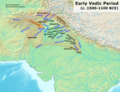 Early Vedic Culture (1700-1100 BCE)
 -
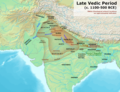 Late Vedic Culture (1100-500 BCE)
 -
 1500-1200 BCE Rigveda, manuscript page sample i, Mandala 1, Hymn 1 (Sukta 1), Adhyaya 1, lines 1.1.1 to 1.1.9, Sanskrit, Devanagari
 -
 1500-1200 BCE, Devi sukta, Rigveda 10.125.1-2, Sanskrit, Devanagari, manuscript page 1735 CE (1792 VS)
 -
 1500-1200 BCE, Vivaha sukta, Rigveda 10.85.16-27, Sanskrit, Devanagari, manuscript page

.png)
.png)
,_Adhyaya_1,_lines_1.1.1_to_1.1.9,_Sanskrit,_Devanagari.jpg)
.jpg)

