Shark anatomy: Difference between revisions
CSV import Tags: mobile edit mobile web edit |
CSV import |
||
| Line 55: | Line 55: | ||
[[Category:Ichthyology]] | [[Category:Ichthyology]] | ||
{{ichthyology-stub}} | {{ichthyology-stub}} | ||
== Shark anatomy gallery == | |||
<gallery> | |||
File:Parts of a shark.svg|Parts of a shark | |||
File:BranchiostomaLanceolatum PioM.svg|Branchiostoma Lanceolatum | |||
File:Parts of a shark fin.png|Parts of a shark fin | |||
File:Updated Shark Anatomy Image.png|Updated Shark Anatomy Image | |||
File:PlacoidComp.png|Placoid Comp | |||
File:Shark Red and White Locomotor Muscles.png|Shark Red and White Locomotor Muscles | |||
File:Tiburón.jpg|Tiburón | |||
File:Unique four chambered heart of shark.png|Unique four chambered heart of shark | |||
File:Shark Anatomy (50693674756).jpg|Shark Anatomy | |||
File:Branquias de tiburón ballena.JPG|Branquias de tiburón ballena | |||
</gallery> | |||
Latest revision as of 05:42, 3 March 2025
Shark Anatomy refers to the physical structure and biological systems of sharks, a group of elasmobranch fish characterized by a cartilaginous skeleton, five to seven gill slits on the sides of the head, and pectoral fins that are not fused to the head.
External Anatomy[edit]
The external anatomy of sharks is defined by several unique characteristics.
Skin[edit]
The skin of a shark is made up of a complex dermal corset made of flexible collagenous fibers and arranged as a helical network surrounding the body. The skin is covered in placoid scales, also known as dermal denticles, which provide a hydrodynamic advantage as the shark moves through water.
Fins[edit]
Sharks have several types of fins, including dorsal fins, pectoral fins, pelvic fins, and a caudal fin. The dorsal fin provides stability while swimming. Pectoral fins assist with steering and lift. Pelvic fins aid in stabilization, and the caudal fin propels the shark forward.
Teeth[edit]
Shark teeth are embedded in the gums rather than directly affixed to the jaw, and are constantly replaced throughout the shark's life. The shape and size of shark teeth vary according to the shark's diet.
Internal Anatomy[edit]
The internal anatomy of sharks includes the skeletal system, digestive system, respiratory system, circulatory system, and sensory systems.
Skeletal System[edit]
Unlike most fish, sharks have a completely cartilaginous skeleton. This reduces the shark's weight and provides additional flexibility.
Digestive System[edit]
The digestive system of a shark includes the mouth, teeth, jaws, esophagus, stomach, intestines, and cloaca. Sharks have a U-shaped stomach that is capable of distending to accommodate large meals.
Respiratory System[edit]
Sharks breathe through a series of five to seven gill slits located on either side of their bodies. Water flows over the gills as the shark swims, allowing oxygen to enter the bloodstream and carbon dioxide to be expelled in a process known as respiration.
Circulatory System[edit]
Sharks have a two-chambered heart and a circulatory system that functions on the principle of single circulation, with the blood passing through the heart only once during each trip around the body.
Sensory Systems[edit]
Sharks have highly developed sensory systems, including sight, smell, taste, hearing, touch, and electroreception. The latter allows them to detect the electric fields produced by other animals, aiding in hunting and navigation.
See Also[edit]
References[edit]
This ichthyology related article is a stub. You can help WikiMD by expanding it.
Shark anatomy gallery[edit]
-
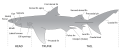 Parts of a shark
 -
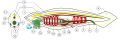 Branchiostoma Lanceolatum
 -
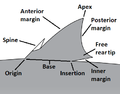 Parts of a shark fin
 -
 Updated Shark Anatomy Image
 -
 Placoid Comp
 -
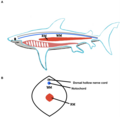 Shark Red and White Locomotor Muscles
 -
 Tiburón
 -
 Unique four chambered heart of shark
 -
 Shark Anatomy
 -
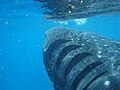 Branquias de tiburón ballena


.jpg)

