Stralsund: Difference between revisions
CSV import Tags: mobile edit mobile web edit |
CSV import |
||
| Line 37: | Line 37: | ||
[[Category:Port cities and towns in Germany]] | [[Category:Port cities and towns in Germany]] | ||
[[Category:Tourism in Germany]] | [[Category:Tourism in Germany]] | ||
<gallery> | |||
File:WLM - 2020 - Stralsund - St. Nikolai Kirche.jpg|St. Nikolai Kirche | |||
File:St.-Marien-Kirche (Stralsund) 2024-05-21 JM 5D412123.jpg|St. Marien Kirche | |||
File:Nikolaikirche Stralsund zur blauen Stunde.jpg|Nikolaikirche zur blauen Stunde | |||
File:Strelasundquerung-Rügenbrücke (10571951483).jpg|Strelasundquerung Rügenbrücke | |||
File:Stralsund, Rathaus und St. Nikolai.jpg|Rathaus und St. Nikolai | |||
File:St. Jakobi (Stralsund).jpg|St. Jakobi | |||
File:Stralsund, Altstadt (2011-05-21) 4.JPG|Stralsund Altstadt | |||
File:STRALSUND nieder.svg|STRALSUND nieder | |||
File:Stralsund, Germany, Rügenbrücke, Pylon und alte Klappbrücke (2006-09-12).JPG|Rügenbrücke, Pylon und alte Klappbrücke | |||
File:Stralsund (2013-07-23), by Klugschnacker in Wikipedia (9).JPG|Stralsund by Klugschnacker | |||
</gallery> | |||
Latest revision as of 05:37, 3 March 2025
Stralsund is a Hanzeatic city located in the Pomeranian region of Germany. It is known for its rich history, unique architecture, and its strategic location on the Baltic Sea.
History[edit]
Stralsund was founded in the 13th century and quickly became a member of the Hanseatic League, a powerful confederation of merchant guilds and market towns in Northwestern and Central Europe. The city's wealth and influence grew rapidly during this period, and it became a major center of trade and commerce.
During the Thirty Years' War, Stralsund successfully resisted a siege by the Swedish Empire, leading to the city's incorporation into Sweden for over a century. The city was later transferred to Prussia in the 19th century, and then became part of the newly formed country of Germany in the late 19th century.
Architecture[edit]
Stralsund is renowned for its well-preserved Gothic architecture, with many of its buildings dating back to the Hanseatic era. The city's historic center is a UNESCO World Heritage Site, and includes notable structures such as the St. Nicholas' Church and the Stralsund City Hall.
Economy[edit]
Today, Stralsund's economy is diverse and robust, with key sectors including tourism, shipbuilding, and biotechnology. The city is also a major transportation hub, with a large port and direct rail and road connections to Berlin and Hamburg.
Culture[edit]
Stralsund is home to several museums, including the German Oceanographic Museum, which is one of the largest of its kind in Europe. The city also hosts a number of festivals and events throughout the year, such as the Stralsund Sailing Week and the Wallenstein Days, a historical reenactment event.
Cuisine[edit]
The cuisine of Stralsund is influenced by its coastal location and its history as a Hanseatic city. Seafood, especially herring, is a staple of the local diet. The city is also known for its beer, with the Störtebeker Brewery being a popular destination for beer enthusiasts.
See also[edit]
This city-related article is a stub. You can help WikiMD by expanding it.

-
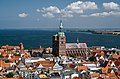 St. Nikolai Kirche
 -
 St. Marien Kirche
 -
 Nikolaikirche zur blauen Stunde
 -
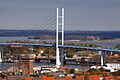 Strelasundquerung Rügenbrücke
 -
Rathaus und St. Nikolai
-
St. Jakobi
-
Stralsund Altstadt
-
STRALSUND nieder
-
Rügenbrücke, Pylon und alte Klappbrücke
-
Stralsund by Klugschnacker

_2024-05-21_JM_5D412123.jpg)

.jpg)


.jpg)
_4.JPG)

.JPG)
,_by_Klugschnacker_in_Wikipedia_(9).JPG)