SN2 reaction: Difference between revisions
CSV import Tags: mobile edit mobile web edit |
CSV import |
||
| Line 37: | Line 37: | ||
{{Chemistry-stub}} | {{Chemistry-stub}} | ||
== SN2 reaction gallery == | |||
<gallery> | |||
File:SN2-MeSH-MeI-montage-3D-balls.png|SN2 MeSH MeI montage 3D balls | |||
File:SN2 reaction.svg|SN2 reaction | |||
File:SN2 reaction orbitals and transition state.svg|SN2 reaction orbitals and transition state | |||
File:Macrocidin A intramolecular etherification.svg|Macrocidin A intramolecular etherification | |||
File:SN2 Walden inversion example.svg|SN2 Walden inversion example | |||
File:Steric effects on SN2 reactivity.svg|Steric effects on SN2 reactivity | |||
File:Benzylic chloride nucleophilic substitution.svg|Benzylic chloride nucleophilic substitution | |||
File:Alcohol to tosylate.svg|Alcohol to tosylate | |||
File:Finkelstein reaction example.svg|Finkelstein reaction example | |||
File:SN2 E2 gas phase competition.svg|SN2 E2 gas phase competition | |||
</gallery> | |||
Latest revision as of 05:35, 3 March 2025
SN2 reaction is a type of nucleophilic substitution where a lone pair from a nucleophile attacks an electron-deficient electrophilic center and bonds to it, expelling another group called a leaving group. This reaction mechanism is one of the two main types of nucleophilic substitution reactions, the other being the SN1 reaction. The term "SN2" stands for "substitution nucleophilic bimolecular." In this mechanism, the nucleophile and substrate collide and react in a single step, making the reaction's rate dependent on the concentration of both the nucleophile and the substrate, hence the term "bimolecular."
Mechanism[edit]
The SN2 reaction mechanism involves a backside attack by the nucleophile on the substrate. This is because the nucleophile approaches the electrophilic carbon from the opposite side of the leaving group. The reaction proceeds through a transition state in which the carbon undergoing substitution is pentacoordinated, and exhibits partial bonds to both the nucleophile and the leaving group. This transition state is characterized by a trigonal bipyramidal geometry. As the reaction proceeds, the bond to the leaving group breaks, and a new bond to the nucleophile is formed, resulting in the inversion of the configuration at the carbon center, known as Walden inversion.
Factors Affecting SN2 Reactions[edit]
Several factors influence the rate and outcome of SN2 reactions:
Substrate Structure[edit]
The structure of the substrate plays a crucial role in SN2 reactivity. Primary alkyl halides are most reactive, followed by secondary alkyl halides. Tertiary alkyl halides are usually unreactive due to steric hindrance that prevents the nucleophile from approaching the electrophilic carbon.
Nucleophile Strength[edit]
The strength of the nucleophile also affects the reaction rate. Stronger nucleophiles, which are typically negatively charged (such as OH−, CN−, or CH3COO−), are more reactive in SN2 reactions than their neutral counterparts.
Leaving Group[edit]
A good leaving group is one that can stabilize the negative charge after departure. Halides (Cl−, Br−, and I−) are considered good leaving groups due to their electronegativity and size.
Solvent[edit]
Polar aprotic solvents, such as acetone, DMF (N,N-Dimethylformamide), and DMSO (Dimethyl sulfoxide), are favorable for SN2 reactions because they do not solvate the nucleophile, allowing it to remain reactive.
Examples[edit]
A classic example of an SN2 reaction is the reaction between sodium hydroxide (NaOH) and methyl bromide (CH3Br), producing methanol (CH3OH) and sodium bromide (NaBr).
Applications[edit]
SN2 reactions are widely used in organic synthesis, including the synthesis of pharmaceuticals, agrochemicals, and polymers. They are particularly useful in the formation of carbon-nitrogen, carbon-oxygen, and carbon-carbon bonds.
See Also[edit]

SN2 reaction gallery[edit]
-
 SN2 MeSH MeI montage 3D balls
 -
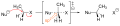 SN2 reaction
 -
 SN2 reaction orbitals and transition state
 -
 Macrocidin A intramolecular etherification
 -
 SN2 Walden inversion example
 -
 Steric effects on SN2 reactivity
 -
 Benzylic chloride nucleophilic substitution
 -
 Alcohol to tosylate
 -
 Finkelstein reaction example
 -
 SN2 E2 gas phase competition


