Mucor racemosus: Difference between revisions
CSV import |
CSV import |
||
| Line 22: | Line 22: | ||
[[Category:Mucoraceae]] | [[Category:Mucoraceae]] | ||
{{Fungus-stub}} | {{Fungus-stub}} | ||
== Mucor racemosus gallery == | |||
<gallery> | |||
File:Mucor racemosus sporangiophore.jpg|Mucor racemosus sporangiophore | |||
File:Mucor racemosus.jpg|Mucor racemosus | |||
</gallery> | |||
Latest revision as of 05:35, 3 March 2025
Mucor racemosus is a species of fungus belonging to the Mucoraceae family. It is a common environmental fungus that is found in soil, plant surfaces, and decaying organic matter. Mucor racemosus is a saprophytic fungus, meaning it feeds on dead or decaying organic material.
Taxonomy[edit]
Mucor racemosus belongs to the Mucorales order, which is the largest order of the Zygomycota phylum. The genus Mucor is characterized by the presence of non-septate hyphae and the formation of sporangia, which are structures that produce and contain spores.
Morphology[edit]
The hyphae of Mucor racemosus are coenocytic, meaning they lack cross-walls or septa. The sporangia are spherical and contain numerous spores. The sporangiophores, which are specialized hyphae that bear the sporangia, are erect and branched.
Ecology[edit]
Mucor racemosus is a ubiquitous fungus, found in a variety of environments including soil, plant surfaces, and decaying organic matter. It plays a crucial role in the decomposition of organic material, contributing to nutrient cycling in ecosystems.
Human Health[edit]
While Mucor racemosus is generally not harmful to healthy individuals, it can cause opportunistic infections in immunocompromised individuals. The most common type of infection caused by Mucor species is mucormycosis, a serious and often deadly fungal infection.
See Also[edit]

Mucor racemosus gallery[edit]
-
 Mucor racemosus sporangiophore
 -
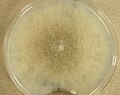 Mucor racemosus


