Sack-back gown: Difference between revisions
CSV import |
CSV import |
||
| Line 25: | Line 25: | ||
{{fashion-stub}} | {{fashion-stub}} | ||
== Sack-back gown gallery == | |||
<gallery> | |||
File:Robe à la Française MET DT207671.jpg|Robe à la Française MET DT207671 | |||
File:Woman's Bed Gown and Petticoat LACMA M.67.8.74a-b (2 of 2).jpg|Woman's Bed Gown and Petticoat LACMA M.67.8.74a-b (2 of 2) | |||
File:Gersaint-detail.jpg|Gersaint detail | |||
File:Declarationoflove.jpg|Declaration of love | |||
File:Woman’s Robe à la Française, Amsterdam, 1740-1760.jpg|Woman’s Robe à la Française, Amsterdam, 1740-1760 | |||
File:Eleanor Frances Dixie by Henry Pickering.jpg|Eleanor Frances Dixie by Henry Pickering | |||
File:Robe à la Française block-printed cotton c. 1770.jpg|Robe à la Française block-printed cotton c. 1770 | |||
File:Wiktor Elpidiforowitsch Borissow-Mussatow 002.jpg|Wiktor Elpidiforowitsch Borissow-Mussatow 002 | |||
File:Tea gown 1899.jpg|Tea gown 1899 | |||
</gallery> | |||
Latest revision as of 05:34, 3 March 2025
Sack-back gown or robe à la française is a women's fashion that evolved in the early 18th century from the earlier robe volante. Characterized by its pleated back, the sack-back gown became a staple of women's fashion from the 1730s to the late 18th century. The gown's construction allowed for a flowing and graceful silhouette, making it a popular choice for formal wear among the European elite.
History[edit]
The sack-back gown's origins can be traced back to the robe volante, a loose-fitting gown that emerged in the late 17th century. By the 1730s, the sack-back gown had become distinct, with its back pleats stitched down to the waist and then released into the skirt. This style allowed for a greater range of movement and a more comfortable fit, contributing to its popularity.
Design and Construction[edit]
The sack-back gown consists of several key components: the bodice, the sack back, and the petticoat. The bodice is fitted to the wearer's torso and typically features a low, square neckline. The sack back is the gown's defining feature, with box pleats at the shoulders that fall loosely down the back to the hem. The petticoat, worn underneath, is often elaborately decorated and visible through the open front of the gown.
Fabrics used for sack-back gowns were typically luxurious, including silk, satin, and brocade, often adorned with lace, ribbons, and floral patterns. The choice of fabric and decoration reflected the wearer's social status and wealth.
Cultural Significance[edit]
The sack-back gown is emblematic of 18th-century fashion and social norms. It was worn by women of the upper classes for formal occasions and is frequently depicted in contemporary portraits and fashion plates. The gown's elaborate design and expensive materials made it a symbol of luxury and femininity.
Preservation and Display[edit]
Many examples of sack-back gowns have been preserved in museum collections around the world. These historical garments provide insight into 18th-century fashion, textile technology, and social history. They are often featured in exhibitions focusing on fashion history and the cultural heritage of the period.
See Also[edit]

Sack-back gown gallery[edit]
-
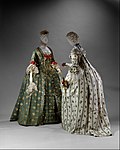 Robe à la Française MET DT207671
 -
 Woman's Bed Gown and Petticoat LACMA M.67.8.74a-b (2 of 2)
 -
 Gersaint detail
 -
 Declaration of love
 -
 Woman’s Robe à la Française, Amsterdam, 1740-1760
 -
 Eleanor Frances Dixie by Henry Pickering
 -
 Robe à la Française block-printed cotton c. 1770
 -
 Wiktor Elpidiforowitsch Borissow-Mussatow 002
 -
 Tea gown 1899

.jpg)


