Binding selectivity: Difference between revisions
CSV import Tags: mobile edit mobile web edit |
CSV import |
||
| Line 36: | Line 36: | ||
{{biochemistry-stub}} | {{biochemistry-stub}} | ||
{{pharma-stub}} | {{pharma-stub}} | ||
== Binding selectivity gallery == | |||
<gallery> | |||
File:Deferiprone.svg|Deferiprone | |||
File:Penicillamine structure.png|Penicillamine structure | |||
File:Sensing.png|Sensing | |||
</gallery> | |||
Latest revision as of 05:33, 3 March 2025
Binding selectivity is the ability of a protein or a receptor to preferentially bind to a particular ligand, among a range of ligand molecules present in a biological system. It is an important concept in biochemistry, pharmacology, and molecular biology.
Overview[edit]
Binding selectivity is essential for the function of an organism's cells. The human body, for instance, contains approximately 100 trillion cells, each of which interacts with its surroundings through a myriad of protein receptors. These receptors are selective for specific ligands.
Factors Influencing Binding Selectivity[edit]
Several factors influence binding selectivity. These include the three-dimensional structure of the ligand and receptor, the presence of other molecules in the system that may interfere with binding, and the relative concentrations of different ligands in the system.
Three-Dimensional Structure[edit]
The three-dimensional structure of both the ligand and the receptor plays a crucial role in binding selectivity. The active site of the receptor must be complementary in shape to the ligand for binding to occur. This is often referred to as the "lock and key" model of ligand-receptor interaction.
Presence of Other Molecules[edit]
The presence of other molecules in the system can also influence binding selectivity. These molecules may compete with the ligand for the active site of the receptor, reducing the likelihood of the ligand binding.
Relative Concentrations[edit]
The relative concentrations of different ligands in the system can also affect binding selectivity. If one type of ligand is present in much higher concentrations than others, it is more likely to bind to the receptor, even if the receptor has a higher affinity for a different ligand.
Implications in Pharmacology[edit]
In pharmacology, binding selectivity is a critical factor in the design of drugs and in the treatment of disease. A drug that is selective for a specific receptor may have fewer side effects and be more effective than a drug that binds to multiple types of receptors.
See Also[edit]
.svg)
This article is a biochemistry stub. You can help WikiMD by expanding it!

Binding selectivity gallery[edit]
-
 Deferiprone
 -
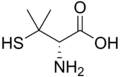 Penicillamine structure
 -
 Sensing


