Cloud iridescence: Difference between revisions
CSV import Tags: mobile edit mobile web edit |
CSV import |
||
| Line 27: | Line 27: | ||
{{Meteorology-stub}} | {{Meteorology-stub}} | ||
== Cloud iridescence gallery == | |||
<gallery> | |||
File:Highly iridising altocumulus.jpg|Highly iridising altocumulus | |||
File:Iridescent cloud at sunset.jpg|Iridescent cloud at sunset | |||
File:Rainbow cloud 1.jpg|Rainbow cloud 1 | |||
File:CircumHorizontalArc GQ 07312012 1938.jpg|Circumhorizontal arc | |||
File:Viet Nam.jpg|Viet Nam | |||
File:Iridclouds2.jpg|Irid clouds | |||
File:IridescentCloudArran.jpg|Iridescent cloud Arran | |||
File:Stratocumulus fibrous fishscali-1.jpg|Stratocumulus fibrous fishscali | |||
File:Iridescent Cloud.JPG|Iridescent cloud | |||
File:Cloud iridescence 3.jpg|Cloud iridescence 3 | |||
</gallery> | |||
Latest revision as of 05:27, 3 March 2025
Cloud iridescence is a meteorological phenomenon characterized by the appearance of colors in a cloud, similar to those seen in oil films on water. It occurs when sunlight or moonlight is diffracted by water droplets or ice crystals present in the cloud, leading to the separation of light into various colors. Cloud iridescence is most often observed in altocumulus, cirrocumulus, lenticular, and cirrus clouds. The phenomenon is relatively rare and is most visible when the sun is positioned directly behind the observer, with the cloud in front, and when the cloud contains droplets or particles of similar size.
Formation[edit]
The formation of cloud iridescence requires specific conditions. Firstly, the cloud must contain large numbers of small water droplets or ice crystals of uniform size. Secondly, the sun or moon must be at a low angle, usually less than 30 degrees above the horizon. Lastly, the observer must be positioned such that the sun or moon is directly behind them, and the cloud is in front. When these conditions are met, diffraction occurs, which is the bending of light waves around obstacles. In the case of cloud iridescence, the water droplets or ice crystals act as the obstacles, causing the light to spread out and separate into different colors.
Observation[edit]
Cloud iridescence is best observed in clouds that are on the verge of dissipating, as these clouds have the thinnest and most uniform droplets or crystals. The phenomenon is often fleeting, lasting only a few minutes before the conditions change and the colors disappear. Observers are advised to shield their eyes from the direct sunlight and to look at the edges of clouds for the best chance of witnessing iridescence.
Scientific Significance[edit]
While cloud iridescence is primarily a visual spectacle, it also has scientific significance. The phenomenon can provide insights into the composition of clouds, including the size distribution of droplets or crystals. This information can be valuable for understanding cloud formation and behavior, as well as for improving models of sunlight scattering in the atmosphere.
Cultural Impact[edit]
Throughout history, cloud iridescence has been observed and documented by various cultures, often imbued with mythological or spiritual significance. In modern times, it continues to inspire artists and photographers, who capture its fleeting beauty.
See Also[edit]
External Links[edit]
- Atmospheric and meteorological phenomena - National Weather Service
- Atmospheric Optics - A resource for optical phenomena in the atmosphere

This article is a meteorology–related stub. You can help WikiMD by expanding it!
Cloud iridescence gallery[edit]
-
 Highly iridising altocumulus
 -
 Iridescent cloud at sunset
 -
 Rainbow cloud 1
 -
 Circumhorizontal arc
 -
 Viet Nam
 -
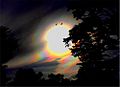 Irid clouds
 -
 Iridescent cloud Arran
 -
 Stratocumulus fibrous fishscali
 -
 Iridescent cloud
 -
 Cloud iridescence 3


