Black hole: Difference between revisions
CSV import Tags: mobile edit mobile web edit |
CSV import |
||
| Line 33: | Line 33: | ||
{{Astrophysics-stub}} | {{Astrophysics-stub}} | ||
<gallery> | |||
File:Black hole - Messier 87 crop max res.jpg|Black hole - Messier 87 | |||
File:Black hole lensing web.gif|Black hole lensing | |||
File:Anatomy of a Black Hole.jpg|Anatomy of a Black Hole | |||
File:Black Hole Shadow.gif|Black Hole Shadow | |||
File:BH-no-escape-1.svg|BH no escape 1 | |||
File:BH-no-escape-2.svg|BH no escape 2 | |||
File:BH-no-escape-3.svg|BH no escape 3 | |||
File:Ergosphere and event horizon of a rotating black hole (no animation).gif|Ergosphere and event horizon of a rotating black hole | |||
File:Images of gas cloud being ripped apart by the black hole at the centre of the Milky Way ESO.jpg|Images of gas cloud being ripped apart by the black hole at the centre of the Milky Way | |||
File:A view of the M87 supermassive black hole in polarised light.tif|A view of the M87 supermassive black hole in polarised light | |||
</gallery> | |||
Latest revision as of 05:23, 3 March 2025
Black hole is a term used in astrophysics to describe a region of space-time exhibiting gravitational acceleration so strong that nothing—no particles or even electromagnetic radiation such as light—can escape from it. The theory of general relativity predicts that a sufficiently compact mass can deform space-time to form a black hole.
History[edit]
The idea of a body so massive that even light could not escape was first proposed by English geologist John Michell in a letter written to Henry Cavendish in 1783. The term "black hole" was coined many years later in 1967 by American astronomer John Wheeler.
Formation[edit]
Black holes are formed from the remnants of large stars following a supernova explosion. If the core remnant of a supernova has a mass greater than about three solar masses, the force of gravity overwhelms all other forces and produces a black hole.
Properties[edit]
Black holes have three "observable" properties: mass, spin (angular momentum), and electric charge. These properties are measurable through their effects on nearby matter and energy.
Types of Black Holes[edit]
There are three types of black holes: stellar black holes, supermassive black holes, and intermediate-mass black holes. Stellar black holes are formed by the gravitational collapse of a single massive star. Supermassive black holes, which are found at the center of nearly all currently known massive galaxies, have masses ranging from millions to billions of solar masses. Intermediate-mass black holes are thought to form through the merging of smaller black holes and stars.
Black Hole Paradox[edit]
The black hole information paradox, proposed by Stephen Hawking, is one of the most intriguing mysteries about black holes. It suggests that physical information could permanently disappear in a black hole, which is a direct violation of quantum mechanics.
See Also[edit]

This article is a astrophysics-related stub. You can help WikiMD by expanding it!
-
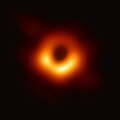 Black hole - Messier 87
 -
 Black hole lensing
 -
 Anatomy of a Black Hole
 -
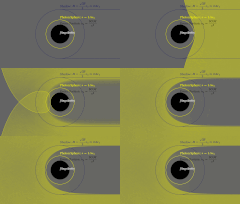 Black Hole Shadow
 -
 BH no escape 1
 -
 BH no escape 2
 -
 BH no escape 3
 -
 Ergosphere and event horizon of a rotating black hole
 -
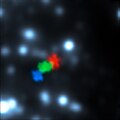 Images of gas cloud being ripped apart by the black hole at the centre of the Milky Way
 -
 A view of the M87 supermassive black hole in polarised light


.gif)

