Azurite: Difference between revisions
CSV import |
CSV import |
||
| Line 28: | Line 28: | ||
[[Category:Copper minerals]] | [[Category:Copper minerals]] | ||
{{geology-stub}} | {{geology-stub}} | ||
<gallery> | |||
File:Azurite - New Nevada Lode, La Sal, Utah, USA.jpg|Azurite - New Nevada Lode, La Sal, Utah, USA | |||
File:Azurite crystal structure.jpg|Azurite crystal structure | |||
File:Azurite, Burra Mine, South Australia.jpg|Azurite, Burra Mine, South Australia | |||
File:Azuritepigment.jpg|Azurite pigment | |||
File:Lady with a Squirrel.jpg|Lady with a Squirrel | |||
File:Madonna and Child Enthroned with Saints.jpg|Madonna and Child Enthroned with Saints | |||
File:Azurite from Arizona, collected by Dr John Hunter in the 18th century, Hunterian Museum, Glasgow.jpg|Azurite from Arizona, collected by Dr John Hunter in the 18th century, Hunterian Museum, Glasgow | |||
File:Mineraly.sk - azurit.jpg|Mineraly.sk - azurit | |||
File:Azurite with Malachite - National Museum of Natural History - Washington, D.C..jpg|Azurite with Malachite - National Museum of Natural History - Washington, D.C. | |||
File:Azurite-23164.jpg|Azurite-23164 | |||
</gallery> | |||
Latest revision as of 05:15, 3 March 2025

Azurite is a soft, deep-blue copper mineral produced by the oxidation of copper ore deposits. It is also known as chessylite after the Chessy-les-Mines near Lyon, France, where striking specimens have been found. The mineral has been known since ancient times, and its vivid blue to deep blue-green color makes it a popular pigment in paints and a decorative stone in jewelry and ornamental objects.
Formation and Characteristics[edit]
Azurite forms when copper-rich water, originating from the oxidation of copper sulfides, interacts with carbonate rocks or minerals. This process leads to the precipitation of azurite along with other copper minerals such as malachite, which is green and often found associated with azurite. The mineral typically occurs in the form of massive aggregates, nodules, or tabular or prismatic crystals. Azurite's blue color is due to the presence of copper (Cu) in its chemical structure, which is a strong coloring agent.
Chemical Composition[edit]
Azurite's chemical formula is Cu₃(CO₃)₂(OH)₂. It belongs to the monoclinic crystal system and has a Mohs hardness of 3.5 to 4, making it relatively soft and suitable for use as a pigment but less so for many types of jewelry.
Uses and Applications[edit]
Historically, azurite was ground and used as a pigment in blue paint and for dyeing cloth. It was highly valued for its vivid color and was a staple in artists' palettes until the development of synthetic pigments. Today, azurite is primarily collected as a mineral specimen or used in jewelry and decorative items. When used in jewelry, it is often cut into cabochons or beads and sometimes treated to enhance its color and durability.
Occurrence[edit]
Azurite is found in many regions around the world, including the United States (notably in Arizona), France, Namibia, Morocco, and Australia. It typically occurs in the oxidized zones of copper deposits alongside malachite, chrysocolla, and other copper-based minerals.
Cultural and Historical Significance[edit]
Azurite has been known since ancient times, with evidence of its use by the ancient Egyptians for decorative purposes and possibly as a cosmetic. The name azurite comes from the Persian word lazhward, which means blue. In the Middle Ages and Renaissance, azurite was a prized pigment for its deep, clear blue color. However, because it can gradually turn green as it ages and converts to malachite, it was eventually replaced by more stable synthetic pigments.
Conservation[edit]
Azurite specimens require careful handling and storage, as they are sensitive to heat, light, and humidity, all of which can cause fading or alteration to malachite. Collectors and museums often store azurite specimens in controlled environments to preserve their vibrant color.
See Also[edit]

-
 Azurite - New Nevada Lode, La Sal, Utah, USA
 -
 Azurite crystal structure
 -
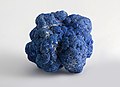 Azurite, Burra Mine, South Australia
 -
 Azurite pigment
 -
 Lady with a Squirrel
 -
 Madonna and Child Enthroned with Saints
 -
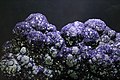 Azurite from Arizona, collected by Dr John Hunter in the 18th century, Hunterian Museum, Glasgow
 -
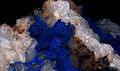 Mineraly.sk - azurit
 -
 Azurite with Malachite - National Museum of Natural History - Washington, D.C.
 -
 Azurite-23164


