Hauts-de-France: Difference between revisions
CSV import Tags: mobile edit mobile web edit |
CSV import |
||
| Line 21: | Line 21: | ||
[[Category:Regions of France]] | [[Category:Regions of France]] | ||
{{France-stub}} | {{France-stub}} | ||
<gallery> | |||
File:Escutcheon fr region Hauts-de-France.svg|Coat of arms of Hauts-de-France | |||
File:Hauts-de-France.svg|Map of Hauts-de-France | |||
File:Notre Dame de Laon, France.jpg|Notre Dame de Laon, France | |||
File:Lille vue gd place.JPG|View of Grand Place, Lille | |||
File:0 Amiens - Place du Don - Cathédrale (1).JPG|Amiens Cathedral | |||
File:France manche vue dover.JPG|View of the English Channel from Dover | |||
</gallery> | |||
Latest revision as of 05:15, 3 March 2025
Hauts-de-France is a region of France created by the territorial reform of French Regions in 2014, coming into existence on 1 January 2016. The region was formed by the merger of three smaller regions: Nord-Pas-de-Calais, Picardy, and parts of the former region of Champagne-Ardenne. Hauts-de-France is located in the northern part of France and is bordered by the English Channel to the north, Belgium to the northeast, the Grand Est region to the east, the Île-de-France region to the south, and Normandy to the west. The capital and largest city of the region is Lille, which is a significant cultural and commercial hub.
Geography[edit]
Hauts-de-France covers an area of approximately 31,813 square kilometers, making it the third smallest of France's mainland regions by area. The region features a variety of landscapes, including coastal areas along the English Channel, rolling hills, and parts of the Ardennes forest. The region is also home to the Somme River, which has historical significance and is a key natural feature.
Economy[edit]
The economy of Hauts-de-France is diverse, with significant contributions from agriculture, manufacturing, and services. The region is known for its production of sugar beets, potatoes, and cereals, as well as its textile and automotive industries. Lille, as the economic center, hosts a number of service and technology companies. Additionally, the region benefits from its proximity to major European capitals and its excellent transportation links, including the Channel Tunnel, which connects France with the United Kingdom.
Culture[edit]
Hauts-de-France has a rich cultural heritage, with influences from both France and Belgium. The region is known for its distinctive architecture, including belfries and town squares that are UNESCO World Heritage Sites. Local cuisine features both French and Flemish influences, with dishes such as carbonnade flamande (a beer and beef stew) and maroilles (a strong-smelling cheese). The region also hosts numerous festivals and events throughout the year, celebrating its history, culture, and traditions.
Demographics[edit]
As of the latest census, Hauts-de-France has a population of approximately 6 million people, making it the third most populous region in France. The region is characterized by a young population, with a significant portion under the age of 30. Immigration has also played a role in shaping the demographic profile, with communities from North Africa, Eastern Europe, and other parts of the world.
Governance[edit]
Hauts-de-France is governed by a regional council, which is responsible for regional planning, transportation, education, and economic development. The council is elected by the residents of the region and is headed by a president. The region is further divided into five departments: Nord, Pas-de-Calais, Somme, Oise, and Aisne, each with its own prefecture and council.
Challenges and Opportunities[edit]
Hauts-de-France faces several challenges, including economic restructuring, unemployment, and social inequality. However, the region also has significant opportunities, particularly in the areas of renewable energy, digital technology, and logistics. The regional government has implemented various initiatives to address these challenges and capitalize on these opportunities, aiming to improve the quality of life for its residents and enhance its attractiveness as a place to live and work.

-
 Coat of arms of Hauts-de-France
 -
 Map of Hauts-de-France
 -
 Notre Dame de Laon, France
 -
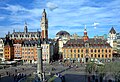 View of Grand Place, Lille
 -
 Amiens Cathedral
 -
 View of the English Channel from Dover


.JPG)

