Irish Rebellion of 1798: Difference between revisions
CSV import |
CSV import |
||
| Line 61: | Line 61: | ||
[[Category:18th-century rebellions]] | [[Category:18th-century rebellions]] | ||
[[Category:Wars involving Great Britain]] | [[Category:Wars involving Great Britain]] | ||
== Irish Rebellion of 1798 gallery == | |||
<gallery> | |||
File:Vinhill.gif|Vinhill | |||
File:Portrait of Theobald Wolf Tone from Catholic University of Leuven.jpg|Portrait of Theobald Wolf Tone from Catholic University of Leuven | |||
File:A new and complete Map of the kingdom of Ireland, drawn from all the surveys and improvements which have hitherto been made ... - btv1b53029317m.jpg|A new and complete Map of the kingdom of Ireland, drawn from all the surveys and improvements which have hitherto been made | |||
File:United irishmen 1.jpg|United Irishmen | |||
File:Irish-Invasion-Gillray.jpeg|Irish Invasion Gillray | |||
File:Pikeman, Wexford.jpg|Pikeman, Wexford | |||
File:Battle of Oulart Hill.jpg|Battle of Oulart Hill | |||
File:Battle of Ballynahinch by Thomas Robinson.jpg|Battle of Ballynahinch by Thomas Robinson | |||
File:Castlebar Races WynneC.jpg|Castlebar Races WynneC | |||
File:WarrensAction1798Ireland.jpg|Warrens Action 1798 Ireland | |||
</gallery> | |||
Latest revision as of 05:12, 3 March 2025
Irish Rebellion of 1798
The Irish Rebellion of 1798 was an uprising against British rule in Ireland lasting from May to September 1798. The rebellion was led by the Society of United Irishmen, a revolutionary group influenced by the ideals of the American Revolution and the French Revolution.
Background[edit]
The late 18th century was a period of significant political and social change in Europe and America. The American War of Independence and the French Revolution inspired many in Ireland to seek similar reforms. The Society of United Irishmen was founded in 1791 by Theobald Wolfe Tone and others, aiming to unite Catholics, Protestants, and Dissenters in the cause of Irish independence.
Causes[edit]
The main causes of the rebellion included widespread discontent with British rule, religious discrimination against Catholics and Presbyterians, and the influence of revolutionary ideas from abroad. The Penal Laws had severely restricted the rights of Catholics, who made up the majority of the population.
The Rebellion[edit]
The rebellion began on 24 May 1798, with uprisings in counties Kildare, Meath, and Wexford. The rebels, poorly armed and organized, faced the well-equipped British forces. Despite initial successes, such as the capture of Enniscorthy and Wexford, the rebellion was ultimately suppressed.
Key Battles[edit]
Aftermath[edit]
The rebellion was crushed by British forces, and thousands of rebels were killed. The defeat led to the Act of Union 1800, which merged the Kingdom of Ireland and the Kingdom of Great Britain into the United Kingdom of Great Britain and Ireland.
Legacy[edit]
The rebellion of 1798 is remembered as a significant event in Irish history, symbolizing the struggle for independence and the desire for a united Irish nation. It inspired future generations of Irish nationalists.
See also[edit]
References[edit]
- Bartlett, Thomas. Ireland: A History. Cambridge University Press, 2010.
- Elliott, Marianne. Wolfe Tone: Prophet of Irish Independence. Yale University Press, 1989.
External links[edit]
Template:Rebellions in Ireland Template:18th-century conflicts Template:Irish history
Irish Rebellion of 1798 gallery[edit]
-
 Vinhill
 -
 Portrait of Theobald Wolf Tone from Catholic University of Leuven
 -
 A new and complete Map of the kingdom of Ireland, drawn from all the surveys and improvements which have hitherto been made
 -
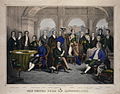 United Irishmen
 -
 Irish Invasion Gillray
 -
 Pikeman, Wexford
 -
 Battle of Oulart Hill
 -
 Battle of Ballynahinch by Thomas Robinson
 -
 Castlebar Races WynneC
 -
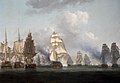 Warrens Action 1798 Ireland


