Lateral talocalcaneal ligament: Difference between revisions
CSV import |
CSV import |
||
| Line 49: | Line 49: | ||
[[Category:Anatomy]] | [[Category:Anatomy]] | ||
{{No image}} | {{No image}} | ||
== Lateral talocalcaneal ligament gallery == | |||
<gallery> | |||
File:Gray356.png|Gray356 | |||
File:Gray359.png|Gray359 | |||
</gallery> | |||
Revision as of 05:10, 3 March 2025
Lateral Talocalcaneal Ligament
The lateral talocalcaneal ligament is a ligament located in the foot that plays a crucial role in maintaining stability and proper alignment of the talus bone and the calcaneus bone. It is one of the key ligaments in the lateral aspect of the foot.
Anatomy
The lateral talocalcaneal ligament is a strong band of fibrous tissue that connects the lateral (outer) side of the talus bone to the calcaneus bone. It is situated deep within the foot, running from the lateral tubercle of the talus to the lateral surface of the calcaneus.
Function
The main function of the lateral talocalcaneal ligament is to provide stability to the subtalar joint, which is the joint formed between the talus and the calcaneus. This ligament helps to prevent excessive inversion (inward rolling) of the foot, which can lead to ankle sprains and other injuries.
Injuries
Injuries to the lateral talocalcaneal ligament can occur due to sudden twisting or rolling of the foot, such as during sports activities or accidents. These injuries are commonly referred to as lateral ankle sprains. When the ligament is stretched or torn, it can result in pain, swelling, and instability of the ankle joint.
Diagnosis and Treatment
Diagnosis of a lateral talocalcaneal ligament injury typically involves a physical examination, medical history review, and imaging tests such as X-rays or MRI scans. Treatment options may vary depending on the severity of the injury, but can include:
- Rest, ice, compression, and elevation (RICE) therapy to reduce pain and swelling.
- Immobilization of the foot and ankle with a brace or cast.
- Physical therapy exercises to improve strength, flexibility, and stability.
- Non-steroidal anti-inflammatory drugs (NSAIDs) to alleviate pain and inflammation.
- In severe cases, surgical intervention may be necessary to repair or reconstruct the damaged ligament.
Prevention
To reduce the risk of lateral talocalcaneal ligament injuries, it is important to take certain preventive measures, such as:
- Wearing appropriate footwear that provides adequate support and stability.
- Engaging in regular exercises to strengthen the muscles around the ankle and foot.
- Avoiding activities or surfaces that increase the risk of ankle sprains, such as uneven terrain or high-impact sports.
- Using ankle braces or taping techniques for added support during physical activities.
See Also
References
<references />
Lateral talocalcaneal ligament gallery
-
 Gray356
 -
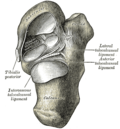 Gray359


