Crop factor: Difference between revisions
CSV import Tags: mobile edit mobile web edit |
CSV import Tags: mobile edit mobile web edit |
||
| Line 28: | Line 28: | ||
[[Category:Photography terminology]] | [[Category:Photography terminology]] | ||
[[Template:Photography]] | [[Template:Photography]] | ||
== Crop factor gallery == | |||
<gallery> | |||
File:Crop Factor.JPG|Crop Factor | |||
File:Full-frame vs APS-C.svg|Full-frame vs APS-C | |||
File:Dslr sensor comparison.jpg|DSLR sensor comparison | |||
File:Objektiv mit kleinbildaequivalenter brennweitenangabe IMGP0111.jpg|Objektiv mit kleinbildäquivalenter brennweitenangabe | |||
File:LensCropFactor.png|Lens Crop Factor | |||
File:Sensorformate KB.svg|Sensorformate KB | |||
</gallery> | |||
Latest revision as of 05:09, 3 March 2025
Crop factor is a term commonly used in photography to describe the relationship between the size of a camera's image sensor and the size of a traditional 35mm film frame. It is an important concept to understand when choosing lenses for a camera, as it affects the effective focal length and field of view.
Definition[edit]
Crop factor, also known as focal length multiplier or lens factor, is a numerical value that represents the ratio of the diagonal measurement of a camera's image sensor to the diagonal measurement of a 35mm film frame. It is typically expressed as a decimal or a fraction.
Calculation[edit]
To calculate the crop factor of a camera, you need to know the size of its image sensor and compare it to the size of a 35mm film frame. The crop factor is determined by dividing the diagonal measurement of the image sensor by the diagonal measurement of a 35mm film frame.
For example, if a camera has an image sensor with a diagonal measurement of 15mm and a 35mm film frame has a diagonal measurement of 43mm, the crop factor would be 43/15, which is approximately 2.87.
Effects of Crop Factor[edit]
The crop factor of a camera affects the effective focal length and field of view of a lens. When a lens is mounted on a camera with a crop factor greater than 1, the lens's focal length is effectively multiplied by the crop factor.
For instance, if a lens with a focal length of 50mm is mounted on a camera with a crop factor of 1.5, the effective focal length would be 50mm x 1.5 = 75mm. This means that the lens would have a narrower field of view compared to when it is used on a full-frame camera.
Applications[edit]
Understanding crop factor is crucial when selecting lenses for a camera. It helps photographers determine the equivalent focal length of a lens on different camera systems. For example, a 50mm lens on a camera with a crop factor of 1.5 would have a similar field of view as a 75mm lens on a full-frame camera.
Crop factor also affects depth of field. Since a lens with a longer effective focal length has a narrower field of view, it tends to produce a shallower depth of field compared to a lens with a shorter focal length.
Conclusion[edit]
Crop factor is an important concept in photography that affects the effective focal length and field of view of a lens. By understanding crop factor, photographers can make informed decisions when selecting lenses for their cameras. It is essential to consider the crop factor when comparing lenses and understanding their impact on image composition and depth of field. Template:Photography
Crop factor gallery[edit]
-
 Crop Factor
 -
 Full-frame vs APS-C
 -
 DSLR sensor comparison
 -
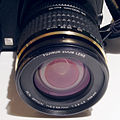 Objektiv mit kleinbildäquivalenter brennweitenangabe
 -
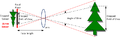 Lens Crop Factor
 -
 Sensorformate KB


