Bird ringing: Difference between revisions
CSV import Tags: mobile edit mobile web edit |
CSV import |
||
| Line 26: | Line 26: | ||
[[Category:Animal marking]] | [[Category:Animal marking]] | ||
{{Ornithology-stub}} | {{Ornithology-stub}} | ||
== Bird ringing gallery == | |||
<gallery> | |||
File:RSPB Sandwell Valley bird ringing - 2004-06-19 - Andy Mabbett - 27.jpg|RSPB Sandwell Valley bird ringing | |||
File:Ringing of black-headed gull Chroicocephalus ridibundus nestling.jpg|Ringing of black-headed gull Chroicocephalus ridibundus nestling | |||
File:Maletín de campo.jpg|Maletín de campo | |||
File:Mist net kinglet.jpg|Mist net kinglet | |||
File:A researcher removes a bird from a mist net 2.jpg|A researcher removes a bird from a mist net | |||
File:A researcher uses a wing ruler to measures a Lincoln's sparrow wing.jpg|A researcher uses a wing ruler to measure a Lincoln's sparrow wing | |||
File:2023-05-12 Goose with neck ring 02.jpg|Goose with neck ring | |||
File:Wing tag Great Frigatebird.JPG|Wing tag Great Frigatebird | |||
File:European roller (Coracias garrulus) 2.jpg|European roller (Coracias garrulus) | |||
File:Gull with bands on both legs.jpg|Gull with bands on both legs | |||
</gallery> | |||
Latest revision as of 05:08, 3 March 2025
Bird ringing or bird banding is the scientific practice of attaching a small, individually numbered metal or plastic tag to the leg or wing of a wild bird to enable individual identification. This method helps researchers track bird migration, life span, survival rate, reproductive success, and population growth, providing valuable data for conservation and scientific studies.
History[edit]
The origins of bird ringing trace back to the early 19th century, with the first recorded attempt made by John James Audubon, an American ornithologist, naturalist, and painter. He tied silver cords to the legs of Eastern Phoebes in Pennsylvania in 1803 to track their return in subsequent years. However, the modern system of bird ringing was established in 1899 by Danish schoolteacher Hans Christian Cornelius Mortensen, who began using numbered aluminum rings to study European birds.
Techniques[edit]
Bird ringing involves capturing birds using nets such as mist nets or cannon nets, carefully attaching a uniquely numbered band to the bird's leg, recording the bird's details (species, age, sex, and condition), and then releasing it. The size and material of the band vary depending on the bird species to ensure minimal impact on the bird's well-being.
Data Collection and Use[edit]
When a ringed bird is later found or recaptured, the unique number on the band provides a link back to the initial data recorded about that bird. This information is crucial for studying migration patterns, longevity, mortality rates, territoriality, feeding behavior, and other aspects of avian biology. Bird ringing data contribute significantly to our understanding of environmental changes, disease transmission among birds, and the effects of habitat destruction on bird populations.
Ethical Considerations[edit]
Bird ringing is conducted under strict ethical guidelines to ensure the welfare of the birds. Only trained and licensed ringers are permitted to ring birds, and they must follow protocols that minimize stress and harm to the birds. The welfare of the bird is always the top priority in bird ringing operations.
Global Efforts and Organizations[edit]
Numerous organizations worldwide coordinate bird ringing efforts, including the British Trust for Ornithology (BTO) in the United Kingdom, the Bird Banding Laboratory (BBL) in the United States, and the European Union for Bird Ringing (EURING). These organizations maintain extensive databases of bird ringing records and support research and conservation projects.
Challenges and Future Directions[edit]
Despite its importance, bird ringing faces challenges such as loss of rings, low recapture rates, and potential impacts on the birds. Advances in technology, such as the use of radio transmitters and GPS devices, complement traditional ringing methods and offer new ways to track birds with greater accuracy and less invasiveness.
Conclusion[edit]
Bird ringing is a vital tool in ornithology, providing insights into the lives of birds that would otherwise be impossible to obtain. Through the dedication of researchers and the support of conservation organizations, bird ringing continues to contribute to our understanding of avian species and their conservation.

Bird ringing gallery[edit]
-
 RSPB Sandwell Valley bird ringing
 -
 Ringing of black-headed gull Chroicocephalus ridibundus nestling
 -
 Maletín de campo
 -
 Mist net kinglet
 -
 A researcher removes a bird from a mist net
 -
 A researcher uses a wing ruler to measure a Lincoln's sparrow wing
 -
 Goose with neck ring
 -
 Wing tag Great Frigatebird
 -
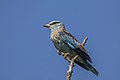 European roller (Coracias garrulus)
 -
 Gull with bands on both legs


_2.jpg)

