RMS Lusitania: Difference between revisions
CSV import |
CSV import |
||
| Line 27: | Line 27: | ||
[[Category:Ships sunk by German submarines in World War I]] | [[Category:Ships sunk by German submarines in World War I]] | ||
{{ship-stub}} | {{ship-stub}} | ||
<gallery> | |||
File:RMS Lusitania coming into port, possibly in New York, 1907-13-crop.jpg|RMS Lusitania coming into port, possibly in New York, 1907-13 | |||
File:House flag of the Cunard Line.svg|House flag of the Cunard Line | |||
File:Lusitania's bow before launch.jpg|Lusitania's bow before launch | |||
File:RMS Lusitania boat.jpg|RMS Lusitania boat | |||
File:Lusitania unloading mail Bain.jpg|Lusitania unloading mail Bain | |||
File:Cassier's Magazine, Lusitania, Early Conception (1904).jpg|Cassier's Magazine, Lusitania, Early Conception (1904) | |||
File:RMS Lusitania deck plans.jpg|RMS Lusitania deck plans | |||
File:Lusitania by Norman Wilkinson, 1907.jpg|Lusitania by Norman Wilkinson, 1907 | |||
File:RMS Lusitania 1st Class Lounge and Music Room.jpg|RMS Lusitania 1st Class Lounge and Music Room | |||
File:Verandah Cafe Lusitania.jpg|Verandah Cafe Lusitania | |||
</gallery> | |||
Latest revision as of 05:07, 3 March 2025
RMS Lusitania was a British ocean liner that was sunk on 7 May 1915 by a German U-boat 11 miles (18 km) off the southern coast of Ireland, killing 1,198 passengers and crew.
History[edit]
The RMS Lusitania was launched by the Cunard Line in 1906, at a time of fierce competition for the North Atlantic trade. She was the world's largest ship until the completion of her sister ship, RMS Mauretania, the following year. The Lusitania made a total of 202 trans-Atlantic crossings.
Sinking[edit]
On the afternoon of 7 May 1915, during the First World War, the Lusitania was torpedoed by the German U-boat U-20. The ship sank in 18 minutes, eight miles off the Old Head of Kinsale, Ireland, killing 1,198 of the 1,959 people aboard. The sinking turned public opinion in many countries against Germany, contributed to the United States' entry into World War I, and became an iconic symbol in military recruiting campaigns of why the war was being fought.
Legacy[edit]
The sinking of the Lusitania was a pivotal event of the First World War, shifting public opinion against Germany and marking a significant escalation in the scale of the conflict. It also led to changes in maritime warfare rules, which were included in the Second Geneva Convention of 1929.
See also[edit]
References[edit]
<references />
External links[edit]
- Lusitania Online - Comprehensive site including passenger and crew lists, and sinking details
- RMS Lusitania Information Resource
 | This article about a specific civilian ship or boat is a stub. You can help WikiMD by expanding the page. |
-
 RMS Lusitania coming into port, possibly in New York, 1907-13
 -
 House flag of the Cunard Line
 -
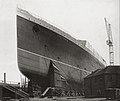 Lusitania's bow before launch
 -
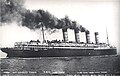 RMS Lusitania boat
 -
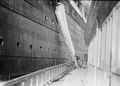 Lusitania unloading mail Bain
 -
 Cassier's Magazine, Lusitania, Early Conception (1904)
 -
 RMS Lusitania deck plans
 -
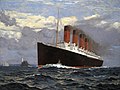 Lusitania by Norman Wilkinson, 1907
 -
 RMS Lusitania 1st Class Lounge and Music Room
 -
 Verandah Cafe Lusitania


.jpg)


