Pulsatilla patens: Difference between revisions
CSV import |
CSV import |
||
| Line 35: | Line 35: | ||
{{DEFAULTSORT:Pulsatilla patens}} | {{DEFAULTSORT:Pulsatilla patens}} | ||
{{No image}} | {{No image}} | ||
<gallery> | |||
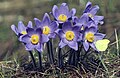
File:Pulsatilla patens01(js).jpg|Pulsatilla patens flower | |||
</gallery> | |||
Revision as of 05:04, 3 March 2025
Pulsatilla patens is a species of flowering plant in the family Ranunculaceae, native to Europe, Russia, Mongolia, China, Canada and the United States. Common names include Eastern pasqueflower, prairie crocus, and cutleaf anemone.
Description
Pulsatilla patens is a perennial herb with a basal rosette of leaves that are finely divided and hairy. The flowers are solitary and bell-shaped, with six petal-like sepals that are blue to purple on the outside and white on the inside. The fruit is a cluster of achenes, each with a long, feathery style.
Distribution and habitat
Pulsatilla patens is found in a wide range of habitats, from dry prairies to open woodlands. It is most common in sandy or rocky soils. In North America, it is found from Alaska to Newfoundland, and south to Colorado and the Great Lakes region.
Cultivation
Pulsatilla patens is cultivated as an ornamental plant for its attractive flowers and feathery seed heads. It prefers a sunny position and well-drained soil. It is hardy to USDA zone 3.
Uses
The plant has been used in traditional medicine for its sedative and analgesic properties. However, it is toxic and should not be used without medical supervision.
Conservation
Pulsatilla patens is considered endangered or threatened in several U.S. states. The main threats to its survival are habitat loss due to development and agriculture, and over-collection for the horticultural trade.
See also
This article is a Ranunculaceae stub. You can help WikiMD by expanding it!
References
<references />
External links
-
 Pulsatilla patens flower
.jpg)

