Block grant: Difference between revisions
CSV import Tags: mobile edit mobile web edit |
CSV import |
||
| Line 30: | Line 30: | ||
[[Category:Federalism in the United States]] | [[Category:Federalism in the United States]] | ||
{{US-gov-stub}} | {{US-gov-stub}} | ||
<gallery> | |||
File:Impact of Block Grant on Budget Constraint.png|Impact of Block Grant on Budget Constraint | |||
</gallery> | |||
Latest revision as of 05:03, 3 March 2025
Block grant is a type of funding provided by the federal government of a country to the local government and state governments. The purpose of a block grant is to support various programs and initiatives in areas such as community development, health care, and education. Unlike categorical grants, which are designated for specific purposes, block grants offer greater flexibility to the recipient in determining how the funds will be used.
History[edit]
The concept of block grants originated in the United States during the Nixon administration in the 1970s. The administration proposed block grants as a means to reduce federal control and give states more power in managing funds. This was part of a broader policy shift towards New Federalism.
Characteristics[edit]
Block grants have several key characteristics. They are:
- Flexible: Block grants can be used for a wide range of purposes, as determined by the recipient government. This flexibility is one of the main advantages of block grants.
- Unrestricted: Unlike categorical grants, block grants do not have stringent requirements or restrictions on their use.
- Discretionary: The federal government has the discretion to decide the amount of block grant to be given to a state or local government.
Advantages and Disadvantages[edit]
Block grants have several advantages. They allow for greater flexibility and discretion in the use of funds, which can lead to more innovative and locally tailored solutions. They also reduce administrative costs as there are fewer regulations to comply with.
However, block grants also have some disadvantages. The lack of specific guidelines can lead to misuse of funds. Additionally, the amount of funding provided through block grants is often less predictable, which can make budget planning more challenging for recipient governments.
See Also[edit]
.svg)
-
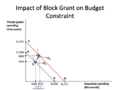 Impact of Block Grant on Budget Constraint

