Resource depletion: Difference between revisions
CSV import Tags: mobile edit mobile web edit |
CSV import Tags: mobile edit mobile web edit |
||
| Line 52: | Line 52: | ||
[[Category:Sustainability]] | [[Category:Sustainability]] | ||
[[Category:Natural Resources]] | [[Category:Natural Resources]] | ||
<gallery> | |||
File:Tar sands in alberta 2008.jpg|Tar sands in Alberta 2008 | |||
File:Trawlers overfishing cod.jpg|Trawlers overfishing cod | |||
File:Sign at an intermittent wetland in Pilliga National Park -5.jpg|Sign at an intermittent wetland in Pilliga National Park | |||
File:Bramiana Wetlands Ierapetra.JPG|Bramiana Wetlands Ierapetra | |||
File:Groundwater flow.svg|Groundwater flow | |||
File:Greed Isn't Green - RNC Tampa 2012.jpg|Greed Isn't Green - RNC Tampa 2012 | |||
</gallery> | |||
Latest revision as of 05:00, 3 March 2025
Resource Depletion[edit]
Resource depletion refers to the exhaustion or reduction of natural resources due to human activities. It occurs when the rate of resource consumption exceeds the rate of natural replenishment, leading to a decline in the availability of essential resources. This article explores the causes, consequences, and potential solutions to resource depletion.
Causes[edit]
Resource depletion can be attributed to various factors, including:
1. Overexploitation: The excessive extraction and utilization of resources, such as fossil fuels, minerals, and forests, without considering their finite nature, contribute to resource depletion. Overfishing and deforestation are examples of overexploitation that can lead to the depletion of marine life and loss of biodiversity.
2. Population growth: The increasing global population puts additional pressure on natural resources. As more people require food, water, energy, and other resources, the demand for these resources rises, leading to their depletion.
3. Industrialization and urbanization: The rapid growth of industries and urban areas requires large amounts of resources to support infrastructure development, manufacturing processes, and energy production. This increased demand can deplete resources at an accelerated rate.
4. Climate change: The changing climate patterns caused by human activities, such as burning fossil fuels, contribute to resource depletion. For example, rising temperatures and changing rainfall patterns can affect water availability, leading to water scarcity in certain regions.
Consequences[edit]
The consequences of resource depletion are far-reaching and can have significant impacts on both the environment and human societies. Some of the key consequences include:
1. Environmental degradation: Resource depletion often leads to environmental degradation, such as deforestation, soil erosion, and habitat destruction. This can result in the loss of biodiversity, disruption of ecosystems, and increased vulnerability to natural disasters.
2. Economic implications: Resource depletion can have adverse effects on economies, particularly in resource-dependent industries. As resources become scarcer, their prices tend to rise, affecting the cost of production and consumer goods. This can lead to economic instability and inequality.
3. Social conflicts: Competition for dwindling resources can give rise to social conflicts, both within and between nations. Disputes over access to water, land, and energy resources have the potential to escalate into conflicts and geopolitical tensions.
4. Impacts on human health: Resource depletion can have indirect impacts on human health. For example, air and water pollution resulting from resource extraction and utilization can lead to respiratory diseases and waterborne illnesses.
Solutions[edit]
Addressing resource depletion requires a combination of strategies and actions at various levels. Some potential solutions include:
1. Sustainable resource management: Adopting sustainable practices that ensure the responsible use and conservation of resources is crucial. This includes implementing efficient extraction techniques, promoting recycling and reuse, and investing in renewable energy sources.
2. Conservation and preservation: Protecting and preserving natural habitats and ecosystems can help prevent resource depletion. This involves establishing protected areas, implementing sustainable forestry practices, and promoting biodiversity conservation.
3. Population control: Managing population growth through education, access to family planning services, and women empowerment can help reduce the strain on resources.
4. Technological advancements: Investing in research and development of innovative technologies can lead to more efficient resource utilization and the development of alternative resources.
See Also[edit]
References[edit]
<references />
-
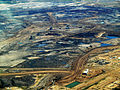 Tar sands in Alberta 2008
 -
 Trawlers overfishing cod
 -
 Sign at an intermittent wetland in Pilliga National Park
 -
 Bramiana Wetlands Ierapetra
 -
 Groundwater flow
 -
 Greed Isn't Green - RNC Tampa 2012


