WiMAX: Difference between revisions
CSV import |
CSV import |
||
| Line 63: | Line 63: | ||
[[Category:Broadband]] | [[Category:Broadband]] | ||
[[Category:Telecommunications]] | [[Category:Telecommunications]] | ||
<gallery> | |||
File:WiMAX Forum logo.svg|WiMAX Forum logo | |||
File:WiMAX equipment.jpg|WiMAX equipment | |||
File:Mobile wimax iad.jpg|Mobile WiMAX IAD | |||
File:Mobile wimax usb.jpg|Mobile WiMAX USB | |||
File:Airstream tm 1200 USB Modem--IMG 8653.jpg|Airstream TM 1200 USB Modem | |||
File:WiMAXArchitecture.svg|WiMAX Architecture | |||
File:pmc wizird.jpg|PMC WiZIRD | |||
File:WiSOA Logo 80px.jpg|WiSOA Logo | |||
File:Wimax.svg|WiMAX | |||
</gallery> | |||
Revision as of 04:58, 3 March 2025
WiMAX
| Type | |
|---|---|
| Inventor | |
| Inception | |
| Manufacturer | |
| Available | |
| Discontinued | |
| Website | [WiMAX Forum Official website] |
| Related articles |
{{This technology related article is a stub.}}
WiMAX (Worldwide Interoperability for Microwave Access) is a family of wireless communication standards based on the IEEE 802.16 set of standards, which provide multiple physical layer (PHY) and media access control (MAC) options.
Overview
WiMAX is a technology for wireless communication that provides high-speed internet access over a wide area. It is similar to Wi-Fi, but it can cover a much larger area and provide service to more users. WiMAX can be used for a variety of applications, including broadband connections, mobile data, and telecommunications.
History
The development of WiMAX began in the early 2000s, with the first version of the standard being released in 2001. The technology was designed to provide a cost-effective alternative to DSL and cable internet services, especially in areas where laying physical cables was not feasible.
Technical Specifications
WiMAX operates on several frequency bands, including the 2.3 GHz, 2.5 GHz, and 3.5 GHz bands. It supports both fixed and mobile deployments, with the ability to provide broadband speeds of up to 1 Gbps for fixed stations and 100 Mbps for mobile stations.
PHY and MAC Layers
The PHY layer of WiMAX is based on orthogonal frequency-division multiplexing (OFDM), which allows for efficient use of the available spectrum. The MAC layer is designed to support a wide range of applications, from simple voice over IP (VoIP) to complex video streaming.
Applications
WiMAX is used in a variety of applications, including:
- Last mile broadband connections
- Backhaul for cellular networks
- Mobile broadband
- Emergency communications
Advantages
WiMAX offers several advantages over traditional wired broadband technologies, including:
- Wide coverage area
- High data rates
- Scalability
- Flexibility in deployment
Challenges
Despite its advantages, WiMAX faces several challenges, such as:
- Competition from other technologies like LTE
- Spectrum availability
- Interference issues
Future of WiMAX
While WiMAX has been largely overshadowed by LTE in recent years, it still has a role to play in certain niche markets and developing regions where its cost-effectiveness and ease of deployment are significant advantages.
See Also
References
- WiMAX Forum
- IEEE 802.16 standards documentation
External Links
-
 WiMAX Forum logo
 -
 WiMAX equipment
 -
Mobile WiMAX IAD
-
 Mobile WiMAX USB
 -
 Airstream TM 1200 USB Modem
 -
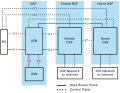 WiMAX Architecture
 -
 PMC WiZIRD
 -
 WiSOA Logo
 -
 WiMAX
WiMAX


