Matairesinol: Difference between revisions
CSV import |
CSV import |
||
| Line 31: | Line 31: | ||
[[Category:Lignans]] | [[Category:Lignans]] | ||
{{Phytochemicals-stub}} | {{Phytochemicals-stub}} | ||
<gallery> | |||
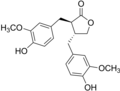
File:Matairesinol.png|Matairesinol | |||
</gallery> | |||
Latest revision as of 04:58, 3 March 2025
Matairesinol is a plant lignan present in the diet that has drawn attention in the scientific community due to its potential health benefits. It is converted in the human body into enterolactone, a compound that has been associated with a reduced risk of certain diseases.
History[edit]
Matairesinol was first identified in 1936 from the bark of the Justicia procumbens plant. Since then, it has been found in a variety of other plants, including flaxseed, sesame seeds, and certain types of berries.
Structure and Properties[edit]
Matairesinol is a type of lignan, a class of compounds characterized by their phenolic structure. It has two phenolic rings connected by a carbon-carbon bond, which gives it its unique chemical properties.
Dietary Sources[edit]
The primary dietary sources of matairesinol are flaxseed and sesame seeds. It is also found in smaller amounts in certain types of berries, vegetables, and grains. The amount of matairesinol in these foods can vary depending on factors such as the plant's growing conditions and the way the food is prepared.
Health Benefits[edit]
Research has suggested that matairesinol may have several health benefits. It is converted in the human body into enterolactone, a compound that has been associated with a reduced risk of certain diseases, including heart disease and cancer.
See Also[edit]
References[edit]
<references />
This article is a Phytochemical-related stub. You can help WikiMD by expanding it!
```
This template is designed to be used at the bottom of articles related to phytochemicals that are considered stubs, indicating that they are short or incomplete and inviting users to contribute by expanding them. The template automatically categorizes tagged articles into a "Phytochemicals stubs" category for easy tracking and improvement.
-
 Matairesinol

