Dahlia anemone: Difference between revisions
No edit summary |
CSV import |
||
| Line 30: | Line 30: | ||
[[Category:Sea anemones]] | [[Category:Sea anemones]] | ||
[[Category:Cnidarians of the Atlantic Ocean]] | [[Category:Cnidarians of the Atlantic Ocean]] | ||
<gallery> | |||
File:Tealiafelina.jpg|Tealia felina | |||
</gallery> | |||
Latest revision as of 04:58, 3 March 2025
Dahlia Anemone[edit]
The Dahlia Anemone (Urticina felina), also known as the Horse Anemone, is a species of sea anemone found in the northeastern Atlantic Ocean. It is notable for its striking appearance and its ability to thrive in a variety of marine environments.
Description[edit]
The Dahlia Anemone is characterized by its large, fleshy body and numerous tentacles that resemble the petals of a dahlia flower. The body, or column, can vary in color from red to brown, often with distinctive patterns or spots. The tentacles are typically arranged in concentric circles around the central mouth.
Habitat[edit]
This species is commonly found attached to rocks, shells, and other hard substrates in the intertidal zone and subtidal areas. It can be found at depths ranging from the low tide mark to about 100 meters. The Dahlia Anemone is well adapted to withstand the harsh conditions of the intertidal zone, including exposure to air and varying salinity levels.
Feeding[edit]
Dahlia Anemones are carnivorous and feed primarily on small fish, crustaceans, and other invertebrates. They use their tentacles to capture prey, which is then immobilized by the anemone's stinging cells, or nematocysts. The prey is then transported to the mouth for digestion.
Reproduction[edit]
Reproduction in Dahlia Anemones can occur both sexually and asexually. Sexual reproduction involves the release of gametes into the water column, where fertilization occurs. Asexual reproduction can occur through a process known as pedal laceration, where small pieces of the anemone's base break off and develop into new individuals.
Ecology[edit]
Dahlia Anemones play an important role in their ecosystem as both predators and prey. They provide habitat and protection for various small marine organisms, including crustaceans and fish. In turn, they are preyed upon by larger animals such as sea stars and certain species of fish.
Related Pages[edit]
-
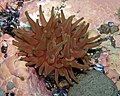 Tealia felina

