Microwave: Difference between revisions
CSV import |
No edit summary |
||
| Line 1: | Line 1: | ||
[[File:Frazier_Peak,_tower_and_Honda_Element.jpg|Frazier Peak, tower and Honda Element|thumb]] | |||
[[File:Atmospheric_Microwave_Transmittance_at_Mauna_Kea_(simulated).svg|Atmospheric Microwave Transmittance at Mauna Kea (simulated)|thumb]] | |||
[[File:Magnetron_section_transverse_to_axis.JPG|Magnetron section transverse to axis|thumb]] | |||
'''Microwave''' is a form of electromagnetic radiation with wavelengths ranging from about one meter to one millimeter; with frequencies between 300 MHz (1 m) and 300 GHz (1 mm). Different sources define different frequency ranges as microwaves; the above broad definition includes both UHF and EHF (millimeter wave) bands. A more common definition in radio-frequency engineering is the range between 1 and 100 GHz (wavelengths between 0.3 m and 3 mm). In all cases, microwaves include the entire SHF band (3 to 30 GHz, or 10 to 1 cm) at minimum. Frequencies in the microwave range are often referred to by their IEEE radar band designations: S, C, X, Ku, K, or Ka band, or by similar NATO or EU designations. | '''Microwave''' is a form of electromagnetic radiation with wavelengths ranging from about one meter to one millimeter; with frequencies between 300 MHz (1 m) and 300 GHz (1 mm). Different sources define different frequency ranges as microwaves; the above broad definition includes both UHF and EHF (millimeter wave) bands. A more common definition in radio-frequency engineering is the range between 1 and 100 GHz (wavelengths between 0.3 m and 3 mm). In all cases, microwaves include the entire SHF band (3 to 30 GHz, or 10 to 1 cm) at minimum. Frequencies in the microwave range are often referred to by their IEEE radar band designations: S, C, X, Ku, K, or Ka band, or by similar NATO or EU designations. | ||
| Line 12: | Line 15: | ||
Exposure to microwaves can have harmful effects on human health. These include burns, cataracts, and some temporary sterility. However, these effects are usually caused by exposure to high levels of microwaves, and the levels found in typical household appliances are generally considered safe. | Exposure to microwaves can have harmful effects on human health. These include burns, cataracts, and some temporary sterility. However, these effects are usually caused by exposure to high levels of microwaves, and the levels found in typical household appliances are generally considered safe. | ||
== Gallery == | |||
== Microwave == | |||
<gallery> | |||
File:Diplexer1.jpg|Diplexer | |||
File:Antennenw1.jpg|Antennen | |||
File:Radar_speed_gun_internal_works.jpg|Radar speed gun internal works | |||
File:SuperDISH121.jpg|SuperDISH121 | |||
File:ASR-9_Radar_Antenna.jpg|ASR-9 Radar Antenna | |||
File:Electrodomésticos_de_línea_blanca_18.JPG|Electrodomésticos de línea blanca | |||
File:Microwave_tunnel_closeup.jpg|Microwave tunnel closeup | |||
</gallery> | |||
== See also == | == See also == | ||
| Line 17: | Line 32: | ||
* [[Radio waves]] | * [[Radio waves]] | ||
* [[Infrared]] | * [[Infrared]] | ||
[[Category:Electromagnetic radiation]] | [[Category:Electromagnetic radiation]] | ||
| Line 26: | Line 38: | ||
{{stub}} | {{stub}} | ||
Latest revision as of 06:16, 2 March 2025

.svg)

Microwave is a form of electromagnetic radiation with wavelengths ranging from about one meter to one millimeter; with frequencies between 300 MHz (1 m) and 300 GHz (1 mm). Different sources define different frequency ranges as microwaves; the above broad definition includes both UHF and EHF (millimeter wave) bands. A more common definition in radio-frequency engineering is the range between 1 and 100 GHz (wavelengths between 0.3 m and 3 mm). In all cases, microwaves include the entire SHF band (3 to 30 GHz, or 10 to 1 cm) at minimum. Frequencies in the microwave range are often referred to by their IEEE radar band designations: S, C, X, Ku, K, or Ka band, or by similar NATO or EU designations.
History[edit]
The discovery of microwaves can be traced back to the 19th century when James Clerk Maxwell presented his theory of electromagnetic radiation in 1864. However, it was not until the 1940s that the technology was developed for practical use, primarily for radar systems during World War II.
Applications[edit]
Microwaves have a wide range of applications including communication, radar, and heating. In communication, they are used in television and radio broadcasting, cell phones, and satellite communication. In radar, they are used to detect objects and measure their distance, speed, and other characteristics. In heating, they are most commonly used in microwave ovens to heat food.
Health effects[edit]
Exposure to microwaves can have harmful effects on human health. These include burns, cataracts, and some temporary sterility. However, these effects are usually caused by exposure to high levels of microwaves, and the levels found in typical household appliances are generally considered safe.
Gallery[edit]
Microwave[edit]
-
 Diplexer
 -
 Antennen
 -
 Radar speed gun internal works
 -
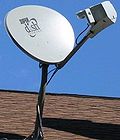 SuperDISH121
 -
 ASR-9 Radar Antenna
 -
 Electrodomésticos de línea blanca
 -
 Microwave tunnel closeup


