Western honey bee: Difference between revisions
Tag: Manual revert |
No edit summary |
||
| Line 1: | Line 1: | ||
[[File:Apis_mellifera_Western_honey_bee.jpg|Apis mellifera Western honey bee|thumb]] | |||
[[File:Historical_introductions_of_western_honey_bees,_Apis_mellifera,_into_the_United_States.svg|Historical introductions of western honey bees, Apis mellifera, into the United States|thumb]] | |||
[[File:A_swarm_of_Apis_mellifera_-_20051109.jpg|A swarm of Apis mellifera|thumb]] | |||
The Western honey bee, scientifically known as Apis mellifera, is a species of bee that is native to Europe, Africa, and the Middle East. It is one of the most well-known and widely studied species of bees, primarily due to its importance in honey production and pollination. | The Western honey bee, scientifically known as Apis mellifera, is a species of bee that is native to Europe, Africa, and the Middle East. It is one of the most well-known and widely studied species of bees, primarily due to its importance in honey production and pollination. | ||
| Line 25: | Line 26: | ||
Despite their importance, Western honey bees face several threats that have led to population declines in recent years. These threats include habitat loss, pesticide exposure, diseases, and parasites. Efforts are being made to protect and conserve honey bee populations through the implementation of sustainable agricultural practices, reduction of pesticide use, and the establishment of protected areas for bee habitats. | Despite their importance, Western honey bees face several threats that have led to population declines in recent years. These threats include habitat loss, pesticide exposure, diseases, and parasites. Efforts are being made to protect and conserve honey bee populations through the implementation of sustainable agricultural practices, reduction of pesticide use, and the establishment of protected areas for bee habitats. | ||
== | == Gallery == | ||
<gallery> | |||
< | File:Bienenwabe_mit_Eiern_und_Brut_5.jpg|Bienenwabe mit Eiern und Brut | ||
File:Bee_on_Lavender_Blossom_2.jpg|Bee on Lavender Blossom | |||
File:Queencell_0017.JPG|Queencell | |||
</gallery> | |||
== See Also == | == See Also == | ||
Latest revision as of 01:03, 28 February 2025


The Western honey bee, scientifically known as Apis mellifera, is a species of bee that is native to Europe, Africa, and the Middle East. It is one of the most well-known and widely studied species of bees, primarily due to its importance in honey production and pollination.
Taxonomy and Classification[edit]
The Western honey bee belongs to the family Apidae, which includes other important bee species such as bumblebees and carpenter bees. It is classified under the genus Apis, which consists of several other honey bee species.
Description[edit]
The Western honey bee is a relatively small insect, measuring around 15 millimeters in length. It has a distinctive yellow and black striped abdomen, with a fuzzy appearance due to the presence of fine hairs. The head and thorax are also covered in hairs, which aid in pollen collection.
Behavior[edit]
Western honey bees are highly social insects, living in large colonies consisting of thousands of individuals. The colony is organized in a hierarchical manner, with a single queen bee, numerous worker bees, and a few male drones. The queen is responsible for laying eggs, while the workers perform various tasks such as foraging for food, building and maintaining the hive, and caring for the young.
Importance[edit]
The Western honey bee plays a crucial role in both agriculture and ecosystems. As pollinators, they are responsible for the fertilization of many flowering plants, including numerous crops that are essential for human food production. Without honey bees, the yield and quality of these crops would be significantly reduced.
Furthermore, Western honey bees are known for their production of honey, which is a valuable food source for humans. Honey is not only delicious but also has various health benefits and is used in numerous culinary and medicinal applications.
Threats and Conservation[edit]
Despite their importance, Western honey bees face several threats that have led to population declines in recent years. These threats include habitat loss, pesticide exposure, diseases, and parasites. Efforts are being made to protect and conserve honey bee populations through the implementation of sustainable agricultural practices, reduction of pesticide use, and the establishment of protected areas for bee habitats.
Gallery[edit]
-
 Bienenwabe mit Eiern und Brut
 -
 Bee on Lavender Blossom
 -
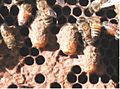 Queencell


