Cultivator: Difference between revisions
CSV import Tags: mobile edit mobile web edit |
CSV import |
||
| Line 35: | Line 35: | ||
[[Category:Agricultural machinery]] | [[Category:Agricultural machinery]] | ||
{{agriculture-stub}} | {{agriculture-stub}} | ||
<gallery> | |||
File:HondaTiller.jpg|Honda Tiller | |||
File:Farmall_C_cultivator.jpg|Farmall C cultivator | |||
File:TractorWithMountedRototiller.JPG|Tractor With Mounted Rototiller | |||
File:TillerTines.jpg|Tiller Tines | |||
File:Farm._Tractor_-_Farm,_Ville_LaSalle_BAnQ_P48S1P08968.jpg|Farm Tractor - Farm, Ville LaSalle | |||
File:Sweep_cultivator_on_the_back_of_a_John_Deere_5220_tractor.jpg|Sweep cultivator on the back of a John Deere 5220 tractor | |||
File:Rotary_tiller_compact.jpg|Rotary tiller compact | |||
</gallery> | |||
Latest revision as of 01:01, 27 February 2025
A cultivator is a piece of agricultural equipment used for secondary tillage. One of its primary purposes is to stir the soil around crops to promote growth and control weeds. Soil cultivation involves both stirring and pulverizing the soil, either before planting to aerate the soil and prepare a smooth, loose seedbed, or after the crop has begun growing to kill weeds—controlled disturbance of the topsoil close to the crops to promote growth and destroy weeds. Unlike a harrow, which disturbs the entire surface of the soil, cultivators are designed to disturb the soil in careful patterns, sparing the crop plants but disrupting the weeds.
Cultivators vary widely in size and shape, from small, hand-held devices to large, heavy machinery. The type of cultivator used depends largely on the scale of the farming operation and the nature of the soil and crop.
Types of Cultivators[edit]
There are several types of cultivators, each designed for specific tasks:
- Hand Cultivator: A small, hand-held tool used for garden and small-scale farming. It is ideal for weeding and aerating soil around plants.
- Tine Cultivator: Features several long, curved tines or teeth. It is pulled behind a tractor, stirring the soil to a specific depth.
- Rotary Cultivator: Also known as a rototiller, it includes rotating blades that churn the soil. It can be either self-propelled or towed behind a tractor.
- Row Crop Cultivator: Designed for cultivating between rows of plants. It often has adjustable arms to fit different row widths and may include shields to protect young plants from the disturbed soil.
Uses and Benefits[edit]
Cultivators are used for various purposes, including:
- Weed Control: By disturbing the soil, cultivators can kill existing weeds and prevent weed seeds from germinating.
- Soil Aeration: Cultivating increases the soil's oxygen content, which is beneficial for plant roots.
- Water Conservation: Loose soil allows rainwater to penetrate more deeply, reducing runoff and conserving water.
- Fertilizer Incorporation: Cultivators can mix fertilizers into the soil, improving nutrient availability to plants.
Environmental Impact[edit]
While cultivators can improve crop production, their use must be managed carefully to prevent soil erosion, loss of organic matter, and disruption of soil structure. Over-cultivation can lead to negative environmental impacts, such as increased susceptibility to erosion.
Innovations in Cultivation Technology[edit]
Advancements in agricultural technology have led to the development of precision cultivators that can target weeds very close to crops, minimizing damage to the plants. GPS and sensor technology allow for more accurate cultivation, reducing the need for chemical weed control and supporting sustainable farming practices.
See Also[edit]
This article is a agriculture stub. You can help WikiMD by expanding it!
-
 Honda Tiller
 -
 Farmall C cultivator
 -
 Tractor With Mounted Rototiller
 -
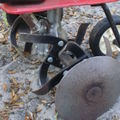 Tiller Tines
 -
 Farm Tractor - Farm, Ville LaSalle
 -
 Sweep cultivator on the back of a John Deere 5220 tractor
 -
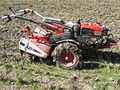 Rotary tiller compact


