Steel square: Difference between revisions
CSV import Tags: mobile edit mobile web edit |
CSV import |
||
| Line 32: | Line 32: | ||
{{construction-stub}} | {{construction-stub}} | ||
<gallery> | |||
File:Steel_Square-1.jpg|Steel Square | |||
File:Stringer_revised.jpg|Stringer Revised | |||
File:Common_rafter_12_pitch_A.jpg|Common Rafter 12 Pitch A | |||
File:hip_jack_and_common_rafter.jpg|Hip Jack and Common Rafter | |||
File:Hip_Rafter_Side_and_Level_Cut.jpg|Hip Rafter Side and Level Cut | |||
File:Common_rafter_layout.jpg|Common Rafter Layout | |||
File:Side_cut_jack_rafter_revised.jpg|Side Cut Jack Rafter Revised | |||
File:Plumbcuts_new.jpg|Plumbcuts New | |||
</gallery> | |||
Latest revision as of 00:57, 27 February 2025
Steel Square
The steel square is a versatile tool used in carpentry and woodworking. It consists of two arms: a longer arm, known as the "blade," and a shorter arm, known as the "tongue." The intersection of these arms forms a right angle, making the tool essential for a variety of tasks including measuring, marking, and ensuring the accuracy of angles and cuts.
History[edit]
The origins of the steel square can be traced back to ancient times, with evidence of its use in Roman and Egyptian construction. However, it was during the 19th century that the tool became standardized and widely used in the construction industry, particularly in the United States and Europe.
Types[edit]
There are several types of steel squares, each designed for specific applications. The most common include the framing square, the combination square, and the try square. The framing square is primarily used in the construction of roofs and staircases, while the combination square serves multiple purposes, including measuring angles, determining flatness, and marking cut lines. The try square is typically used for more precise work, such as cabinetry and joinery.
Usage[edit]
The steel square is an indispensable tool for carpenters and woodworkers. It is used to mark out cuts on timber, check the squareness of an edge, and lay out right angles. Additionally, the framing square can be used to calculate rafter lengths, roof pitches, and other complex measurements required in construction.
Reading a Steel Square[edit]
Understanding the graduations and markings on a steel square is crucial for its effective use. The blade and tongue are typically marked with a variety of scales, including inch measurements, rafter tables, and octagon scales. Learning to read these scales allows the user to perform complex calculations and measurements without the need for additional tools.
Maintenance[edit]
To ensure accuracy and longevity, it is important to maintain the steel square properly. This includes regular cleaning, avoiding rust, and storing the tool in a dry place. It is also advisable to periodically check the squareness of the tool, as drops or heavy use can cause it to become inaccurate.
In Popular Culture[edit]
The steel square has been referenced in literature and film, often symbolizing craftsmanship, precision, and the importance of a strong foundation. Its role in construction and woodworking underscores its significance in building not just structures, but also in shaping the environment and communities.
See Also[edit]
This construction related article is a stub. You can help WikiMD by expanding it.
-
 Steel Square
 -
 Stringer Revised
 -
 Common Rafter 12 Pitch A
 -
 Hip Jack and Common Rafter
 -
 Hip Rafter Side and Level Cut
 -
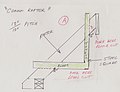 Common Rafter Layout
 -
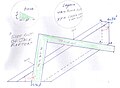 Side Cut Jack Rafter Revised
 -
 Plumbcuts New


