Castor and Pollux: Difference between revisions
CSV import |
CSV import |
||
| Line 17: | Line 17: | ||
[[Category:Greek mythology]] | [[Category:Greek mythology]] | ||
{{myth-stub}} | {{myth-stub}} | ||
<gallery> | |||
File:Castor_Pollux_anagoria.JPG|Castor Pollux anagoria | |||
File:Kastor_Niobid_krater_Louvre_G341.jpg|Kastor Niobid krater Louvre G341 | |||
File:Boiotian_proxeny_decree_with_relief_of_Athena_and_Dioskouroi_(Boston_MFA_1987.297).jpg|Boiotian proxeny decree with relief of Athena and Dioskouroi | |||
File:Peter_Paul_Rubens_-_The_Rape_of_the_Daughters_of_Leucippus.jpg|Peter Paul Rubens - The Rape of the Daughters of Leucippus | |||
File:I_dioscuri_a_cavallo_sostenuti_da_tritoni,_dal_santuario_di_marasà_a_locri,_450-400_ac_ca._01.jpg|I dioscuri a cavallo sostenuti da tritoni, dal santuario di marasà a locri | |||
File:Antiochos_VI_with_Dioscuri.jpg|Antiochos VI with Dioscuri | |||
File:Castor_or_Pollux,_probably_Italy,_2nd_century_CE_-_Nelson-Atkins_Museum_of_Art_-_DSC08246.JPG|Castor or Pollux, probably Italy, 2nd century CE | |||
File:RomaForoRomanoTempioCastori.jpg|Roma Foro Romano Tempio Castori | |||
</gallery> | |||
Latest revision as of 00:57, 27 February 2025
Castor and Pollux are figures from Greek mythology, known together as the Dioscuri. Their story is a rich tapestry of adventure, brotherhood, and divine intervention, deeply intertwined with the culture and religion of ancient Greece. They are considered to be the sons of Leda, but they have different fathers; Castor was the mortal son of Tyndareus, the king of Sparta, while Pollux was the divine son of Zeus, who seduced Leda in the guise of a swan. This dual paternity rendered Pollux immortal and Castor mortal.
Mythology[edit]
The myths surrounding Castor and Pollux are numerous and varied, but they are most famous for their inseparable bond and their adventures together. They are often depicted as skilled horsemen and boxers. One of the most celebrated stories involves their participation in the quest for the Golden Fleece as members of the Argonauts. Another notable myth is their abduction of the daughters of Leucippus, Phoebe and Hilaeira, which led to a feud with their cousins, culminating in Castor's death.
Following Castor's death, Pollux was inconsolable and begged Zeus to let him share his immortality with his brother. Moved by Pollux's love, Zeus allowed them to split their time between the underworld and Olympus, thus keeping them together forever. This act also placed them among the stars as the constellation Gemini.
Cult and Worship[edit]
The cult of Castor and Pollux was widespread in ancient Greece and Rome. They were venerated as protectors of sailors and soldiers, often invoked for their legendary prowess and ability to save those in dire need. Their most famous sanctuary was the Temple of Castor and Pollux in the Roman Forum, a testament to their importance in Roman religion and society.
Representation in Art and Culture[edit]
Castor and Pollux have been depicted in various forms of art throughout history, from ancient pottery to Renaissance paintings. They are often shown as identical young men, sometimes with stars above their heads to signify their divine status and connection to the constellation Gemini. Their story has also inspired countless works of literature and drama, underscoring their enduring legacy in Western culture.
Legacy[edit]
The legacy of Castor and Pollux extends beyond mythology and into the stars, with their story symbolizing the bond of brotherhood and the interplay between mortality and divinity. Their presence in the constellation Gemini serves as a celestial reminder of their adventures and the power of familial love.
This article is a mythology-related stub. You can help WikiMD by expanding it!
-
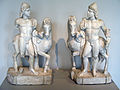 Castor Pollux anagoria
 -
Kastor Niobid krater Louvre G341
-
Boiotian proxeny decree with relief of Athena and Dioskouroi
-
Peter Paul Rubens - The Rape of the Daughters of Leucippus
-
I dioscuri a cavallo sostenuti da tritoni, dal santuario di marasà a locri
-
Antiochos VI with Dioscuri
-
Castor or Pollux, probably Italy, 2nd century CE
-
Roma Foro Romano Tempio Castori


.jpg)


