Helicoverpa zea: Difference between revisions
CSV import Tags: mobile edit mobile web edit |
CSV import |
||
| Line 26: | Line 26: | ||
{{Insect-stub}} | {{Insect-stub}} | ||
{{food-stub}} | {{food-stub}} | ||
<gallery> | |||
File:Helicoverpa_zea_-_Corn_Earworm_Moth_(14609135305).jpg|Helicoverpa zea - Corn Earworm Moth | |||
File:Helicoverpa_zea1.jpg|Helicoverpa zea | |||
File:Corn_earworm,_eggs_2014-06-06-10.46.51_ZS_PMax_(15938018542).jpg|Corn earworm, eggs | |||
File:Helicoverpa_zea_larva.jpg|Helicoverpa zea larva | |||
File:Bulletin_(1904)_(20434613611).jpg|Bulletin (1904) | |||
File:Bulletin_(1904)_(20240353210).jpg|Bulletin (1904) | |||
File:K5557-9.jpg|K5557-9 | |||
File:Corn_earworm_moth.jpg|Corn earworm moth | |||
</gallery> | |||
Latest revision as of 00:57, 27 February 2025
Helicoverpa zea, commonly known as the corn earworm, is a species of moth in the family Noctuidae. It is a major agricultural pest, known to cause significant damage to a wide variety of crops.
Description[edit]
The adult Helicoverpa zea is a medium-sized moth with a wingspan of approximately 35-40mm. The forewings are typically a pale brown color, while the hindwings are lighter with a dark band along the outer edge. The larvae, or caterpillars, are highly variable in color, ranging from light green to dark brown.
Distribution and Habitat[edit]
Helicoverpa zea is found throughout the Americas, from Canada to Argentina. It is particularly prevalent in the southern United States, where it is a major pest of corn and cotton crops. The species is highly adaptable and can be found in a variety of habitats, including agricultural fields, gardens, and wildlands.
Life Cycle[edit]
The life cycle of Helicoverpa zea includes four stages: egg, larva, pupa, and adult. The female moth lays her eggs on the leaves or silk of host plants. After hatching, the larvae feed on the plant tissue, often burrowing into the fruit or ear of the crop. The larvae then pupate in the soil, emerging as adults after approximately two weeks.
Economic Impact[edit]
As a major agricultural pest, Helicoverpa zea causes significant economic losses each year. The larvae feed on a wide variety of crops, including corn, cotton, tomatoes, and soybeans. In addition to direct crop damage, the species can also contribute to the spread of plant diseases.
Control[edit]
Control of Helicoverpa zea typically involves a combination of cultural practices, biological control agents, and chemical insecticides. Crop rotation and the use of resistant varieties can help to reduce the impact of the pest. Biological control agents, such as parasitic wasps and predatory beetles, can also be effective in controlling populations.
See Also[edit]

-
 Helicoverpa zea - Corn Earworm Moth
 -
 Helicoverpa zea
 -
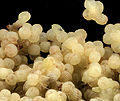 Corn earworm, eggs
 -
 Helicoverpa zea larva
 -
Bulletin (1904)
-
Bulletin (1904)
-
K5557-9
-
Corn earworm moth
.jpg)

.jpg)


_(20434613611).jpg)
_(20240353210).jpg)

