List of cocaine analogues: Difference between revisions
CSV import |
CSV import |
||
| Line 34: | Line 34: | ||
{{Pharmacology-stub}} | {{Pharmacology-stub}} | ||
{{Chemistry-stub}} | {{Chemistry-stub}} | ||
== List of cocaine analogues == | |||
<gallery> | |||
File:Cocaine_positions_tropane-ring_only.png|Cocaine positions tropane-ring only | |||
File:Cocaine_positions_numbered.PNG|Cocaine positions numbered | |||
File:CocaineHCl.svg|Cocaine HCl | |||
File:R-cocaine.svg|R-cocaine | |||
File:R-pseudococaine.svg|R-pseudococaine | |||
File:R-allococaine.svg|R-allococaine | |||
File:R-allopseudococaine.svg|R-allopseudococaine | |||
File:S-cocaine.svg|S-cocaine | |||
</gallery> | |||
Latest revision as of 00:55, 27 February 2025
List of Cocaine Analogues
Cocaine, a powerful stimulant drug derived from the leaves of the coca plant, has numerous analogues that have been synthesized to mimic its structure and pharmacological effects. These analogues vary in potency, duration of action, and legal status across different jurisdictions. This article provides an overview of some of the most notable cocaine analogues, highlighting their chemical properties, effects, and relevance in both medical research and illicit drug markets.
Overview[edit]
Cocaine (benzoylmethylecgonine) is a tropane alkaloid and stimulant drug well-known for its use in both medical settings as a local anesthetic and in recreational settings for its euphoric effects. Due to its high potential for abuse and addiction, there has been significant interest in developing analogues of cocaine that could offer therapeutic benefits with reduced abuse potential. Additionally, synthetic analogues have been produced illicitly to circumvent drug laws.
Common Cocaine Analogues[edit]
RTI-111 (Dichloropane)[edit]
RTI-111, also known as dichloropane, is a synthetic analogue of cocaine that has a similar mechanism of action but with a significantly longer duration of effect. It has been researched for its potential use in treating cocaine addiction but is also subject to abuse.
WIN 35428[edit]
WIN 35428, chemically known as CFT, is a potent dopamine reuptake inhibitor that has been used extensively in scientific research to understand the neurochemical mechanisms underlying cocaine addiction. It is not intended for human consumption.
Benztropine[edit]
Benztropine is an anticholinergic compound with stimulant properties similar to cocaine. It is primarily used in the treatment of Parkinson's disease and drug-induced extrapyramidal disorders. Despite its medical uses, it has a potential for abuse.
Troparil[edit]
Troparil is a potent cocaine analogue and reuptake inhibitor of dopamine and norepinephrine, making it of interest for research into stimulant abuse and potential therapeutic applications. Its structure closely resembles that of cocaine, but it is not used medically.
Legal Status and Concerns[edit]
The legal status of cocaine analogues varies significantly by country and jurisdiction. Many have been classified as controlled substances due to their potential for abuse and similarity to cocaine. The synthesis and distribution of these substances are often regulated to prevent misuse.
Research and Medical Use[edit]
Research into cocaine analogues continues to be an active area of study, with the goal of finding compounds that can retain beneficial effects, such as local anesthesia, without the high abuse potential associated with cocaine. Some analogues are also used in research models to study addiction and the neurochemical pathways involved in stimulant abuse.
Conclusion[edit]
Cocaine analogues represent a diverse group of compounds with varying effects, potencies, and applications. While some hold promise for medical use and research, their potential for abuse necessitates careful regulation and monitoring. Ongoing research into these substances may provide valuable insights into addiction and lead to the development of new therapeutic agents.


List of cocaine analogues[edit]
-
 Cocaine positions tropane-ring only
 -
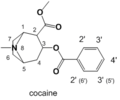 Cocaine positions numbered
 -
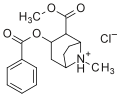 Cocaine HCl
 -
 R-cocaine
 -
 R-pseudococaine
 -
 R-allococaine
 -
 R-allopseudococaine
 -
 S-cocaine


