Betula nigra: Difference between revisions
CSV import |
CSV import |
||
| Line 21: | Line 21: | ||
[[Category:Betula]] | [[Category:Betula]] | ||
{{trees-stub}} | {{trees-stub}} | ||
<gallery> | |||
File:RiverBirchBark01.JPG|River Birch Bark | |||
File:River_Birch_Seeds.JPG|River Birch Seeds | |||
File:River_Birch_Trunk.JPG|River Birch Trunk | |||
File:River_Birch_Middle.JPG|River Birch Middle | |||
File:Betula_nigra_(river_birch)_(27880297709).jpg|Betula nigra (river birch) | |||
File:River_Birch_at_Skyfields_Arboretum,_Athol_MA.jpg|River Birch at Skyfields Arboretum, Athol MA | |||
File:River_Birch_Washington_DC.jpg|River Birch Washington DC | |||
File:Mature_river_birch.jpg|Mature River Birch | |||
</gallery> | |||
Latest revision as of 00:53, 27 February 2025
Betula nigra, also known as the river birch, is a species of birch native to the eastern United States. It is commonly found in flood plains and swamps. It is recognized for its distinctive, flaky bark.
Description[edit]
The Betula nigra is a medium-sized deciduous tree that typically grows to a height of 60 to 80 feet. The tree has a broad, rounded crown and a light, airy appearance. The bark of the Betula nigra is one of its most notable features. It is brownish in color, and peels off in thin, papery layers.
Habitat and Distribution[edit]
The Betula nigra is native to the eastern United States, from New Hampshire to southern Minnesota, and south to Texas and Florida. It is commonly found in flood plains and swamps, and is well-adapted to areas that experience periodic flooding.
Cultivation and Uses[edit]
The Betula nigra is often cultivated as an ornamental tree due to its attractive bark and its resistance to birch borer, a common pest of birch trees. It is also used in land reclamation projects due to its ability to grow in waterlogged soil.
Conservation Status[edit]
The Betula nigra is not currently considered to be at risk of extinction. However, like all species, it is affected by habitat loss and changes in its environment.
See Also[edit]
This tree-related article is a stub. You can help WikiMD by expanding it.
-
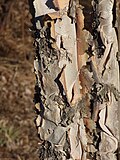 River Birch Bark
 -
 River Birch Seeds
 -
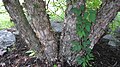 River Birch Trunk
 -
 River Birch Middle
 -
 Betula nigra (river birch)
 -
 River Birch at Skyfields Arboretum, Athol MA
 -
 River Birch Washington DC
 -
 Mature River Birch


_(27880297709).jpg)


