Salmonella virus P22: Difference between revisions
CSV import Tags: mobile edit mobile web edit |
CSV import |
||
| Line 33: | Line 33: | ||
{{Virus-stub}} | {{Virus-stub}} | ||
<gallery> | |||
File:Bacteriophage_P22.tif|Bacteriophage P22 | |||
File:P22likevirus_virion.jpg|P22-like virus virion | |||
</gallery> | |||
Latest revision as of 00:36, 27 February 2025
Salmonella Phage P22 is a bacteriophage that infects the bacterium Salmonella enterica serotype Typhimurium. As a member of the Podoviridae family, it has a short, non-contractile tail and an icosahedral head. The P22 phage is a well-studied model organism in molecular biology and genetics, particularly in the areas of phage biology, horizontal gene transfer, and the mechanisms of DNA packaging.
Overview[edit]
Phage P22 is a temperate phage, meaning it can choose between a lytic and a lysogenic lifecycle. In the lytic cycle, P22 infects the bacterium, replicates its DNA, and eventually causes the host cell to lyse, releasing new phage particles. In the lysogenic cycle, the phage integrates its genome into the host cell's chromosome and replicates along with it, without killing the host. This integrated phage DNA is known as a prophage.
Genome and Structure[edit]
The genome of P22 is a double-stranded DNA molecule approximately 43 kilobases in length. It encodes for about 60 genes, which are involved in the phage's replication, assembly, and cell lysis processes. The structure of P22 includes an icosahedral head where the DNA is packaged and a short tail through which the DNA is injected into the host cell.
Life Cycle[edit]
Upon infection, P22 attaches to the outer membrane of Salmonella using its tail fibers. The tail then contracts, injecting the phage DNA into the host cell. Depending on the environmental conditions and the genetic state of the phage and host, P22 will enter either the lytic or lysogenic cycle.
Lytic Cycle[edit]
In the lytic cycle, P22 takes over the host's machinery to replicate its DNA and produce new phage components. These components are assembled into mature virions, which are then released into the environment through cell lysis, killing the host.
Lysogenic Cycle[edit]
In the lysogenic cycle, P22's DNA integrates into the host's chromosome and is replicated along with the host's DNA during cell division. The phage can remain in this state indefinitely. However, under certain conditions, such as DNA damage to the host cell, the prophage can be induced to exit the chromosome and enter the lytic cycle.
Applications in Research[edit]
P22 has been extensively used as a tool in genetic and molecular biology research. Its ability to transduce DNA between Salmonella cells has made it valuable in studies of bacterial genetics. Additionally, the mechanisms of P22's DNA packaging and assembly have provided insights into viral assembly and the regulation of gene expression.
Health Implications[edit]
While P22 specifically infects Salmonella bacteria, it does not directly cause disease in humans. However, understanding bacteriophages like P22 is crucial for developing phage therapy as an alternative to antibiotics, especially in the face of increasing antibiotic resistance.
See Also[edit]

-
 Bacteriophage P22
 -
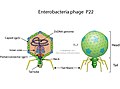 P22-like virus virion

