Bills of mortality: Difference between revisions
CSV import |
CSV import |
||
| Line 28: | Line 28: | ||
{{medicine-stub}} | {{medicine-stub}} | ||
== Bills_of_mortality == | |||
<gallery> | |||
File:Bill_of_Mortality.jpg|Bill of Mortality | |||
File:Journal.pone.0008401.g004.png|Journal pone 0008401 g004 | |||
</gallery> | |||
Latest revision as of 21:03, 25 February 2025
Bills of Mortality were weekly mortality statistics in London, England, dating from the late 16th century. They recorded the number of deaths in the city and the causes of death. Initially, these bills were a response to the bubonic plague outbreaks, but over time, they became a regular record-keeping system for all causes of death. The Bills of Mortality offer a fascinating glimpse into the public health, social history, and demography of early modern London.
History[edit]
The practice of recording deaths and their causes began in earnest in 1592, during a severe outbreak of the plague. The Church of England parish clerks were tasked with compiling weekly tallies of burials and christenings, a practice that was formalized and continued regularly from 1603. These records were important for monitoring the health of the city and were used by the government and city officials to gauge the severity of plague outbreaks and other public health crises.
Content and Format[edit]
Each bill contained the number of christenings and burials within the city for that week, along with a list of causes of death. The causes were often described in terms that are now considered vague or inaccurate, such as "rising of the lights" for deaths that would now likely be attributed to pneumonia or other respiratory illnesses. The bills also included deaths from accidents, such as drownings or falls, and occasionally, more unusual causes of death.
Significance[edit]
The Bills of Mortality are an invaluable resource for historians and demographers. They provide insight into the health conditions of London over several centuries, including the impact of epidemics like the plague. The data from the bills have been used to study the spread of diseases, the effectiveness of quarantine measures, and the overall mortality rates of the population.
John Graunt and the Bills of Mortality[edit]
One of the most significant figures associated with the Bills of Mortality is John Graunt. In 1662, Graunt published Natural and Political Observations Made upon the Bills of Mortality, a groundbreaking work that analyzed the data from the bills. Graunt is considered by many to be the first demographer, and his work laid the foundation for the fields of statistics and epidemiology. He introduced the concept of life tables and made observations on the patterns of diseases and other causes of death.
Legacy[edit]
The practice of compiling Bills of Mortality continued into the 19th century, eventually being superseded by more modern systems of vital registration. However, the historical records remain a crucial source for understanding the social and health conditions of the past. The Bills of Mortality also marked an early attempt at systematic public health surveillance, a practice that is vital to modern public health efforts.
See Also[edit]

Bills_of_mortality[edit]
-
 Bill of Mortality
 -
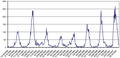 Journal pone 0008401 g004


