Blitum virgatum: Difference between revisions
CSV import Tags: mobile edit mobile web edit |
CSV import |
||
| Line 28: | Line 28: | ||
[[Category:Amaranthaceae]] | [[Category:Amaranthaceae]] | ||
{{plant-stub}} | {{plant-stub}} | ||
<gallery> | |||
File:Chenopodium_foliosum.JPG|Chenopodium foliosum | |||
</gallery> | |||
Latest revision as of 21:02, 25 February 2025
Blitum virgatum is a species of flowering plant in the family Amaranthaceae. It is commonly known as leafy goosefoot or synthetic goosefoot. This plant is native to Europe and Asia, but has been introduced to other parts of the world, including North America.
Description[edit]
Blitum virgatum is an annual plant that can grow up to 1 meter tall. The leaves are alternate, simple, and entire or slightly lobed. The flowers are small, green, and arranged in dense spikes. The fruit is a small, round, black seed.
Habitat and Distribution[edit]
Blitum virgatum is found in a variety of habitats, including fields, waste areas, and roadsides. It prefers well-drained soils and can tolerate a wide range of pH levels. The plant is native to Europe and Asia, but has been introduced to other parts of the world, including North America.
Uses[edit]
Blitum virgatum has been used as a food source in some cultures. The leaves can be eaten raw or cooked, and the seeds can be ground into a flour. The plant is also used in traditional medicine for various ailments.
Cultivation[edit]
Blitum virgatum is not commonly cultivated, but it can be grown from seed. The plant prefers full sun and well-drained soil. It is relatively easy to grow and requires little maintenance.
Conservation Status[edit]
Blitum virgatum is not currently considered to be at risk of extinction. However, like all wild plants, it is vulnerable to habitat loss and other environmental changes.
See Also[edit]
References[edit]
- Flora of North America
- Flora of Europe

-
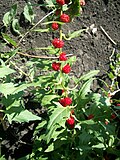 Chenopodium foliosum

