Secondary growth: Difference between revisions
CSV import Tags: mobile edit mobile web edit |
CSV import |
||
| Line 23: | Line 23: | ||
{{Botany-stub}} | {{Botany-stub}} | ||
<gallery> | |||
File:Tree_swallowing_lamp_post.JPG|Tree swallowing lamp post | |||
File:Tree_secondary_growth_diagram.svg|Tree secondary growth diagram | |||
File:Monocot_Stem.jpg|Monocot Stem | |||
</gallery> | |||
Latest revision as of 21:00, 25 February 2025
Secondary growth refers to the process in which plants increase in girth or thickness in a lateral manner, through the activity of the cambium. This growth is in contrast to primary growth, which is the elongation of plant tissues and organs. Secondary growth is characteristic of many dicotyledons and gymnosperms but is absent in most monocotyledons. The process is significant for the production of wood and the thickening of stems and roots.
Overview[edit]
Secondary growth occurs through the activities of two types of lateral meristems: the vascular cambium and the cork cambium (or phellogen). The vascular cambium produces secondary xylem (wood) to the inside and secondary phloem to the outside. The cork cambium gives rise to the periderm, which replaces the epidermis in mature plant parts. Together, these processes result in the thickening of the plant organs in which they occur.
Vascular Cambium[edit]
The vascular cambium is a cylinder of meristematic cells located between the primary xylem and phloem. It is responsible for the majority of secondary growth and wood production in trees. The cambium cells divide to produce new cells either towards the inside, forming secondary xylem, or towards the outside, forming secondary phloem. Over time, the accumulation of secondary xylem results in the significant thickening of the stem or root, contributing to the formation of wood.
Cork Cambium[edit]
The cork cambium, another lateral meristem, arises in the outer cortex of stems and roots. Its primary function is to produce the periderm, a protective layer that replaces the epidermis as the outermost layer. The periderm consists of the cork (phellem), the cork cambium, and the phelloderm. The cork acts as a barrier against physical damage and prevents water loss, playing a crucial role in the survival of the plant.
Significance of Secondary Growth[edit]
Secondary growth not only contributes to the structural support of a plant by thickening the stems and roots but also plays a critical role in the plant's ability to transport water and nutrients. As plants grow taller, the demand for mechanical support and efficient water transport increases. Secondary growth addresses these needs by producing wood, which provides strength and facilitates the upward movement of water and minerals from the roots to the leaves.
Ecological and Economic Importance[edit]
Wood, the primary product of secondary growth, has significant ecological and economic importance. It serves as a habitat and food source for various organisms and is a critical resource for humans, used in construction, paper production, and as a fuel. The study of secondary growth processes also has implications for understanding and mitigating the effects of climate change, as trees play a vital role in carbon sequestration.
Conclusion[edit]
Secondary growth is a complex process that plays a vital role in the life of many plants. It contributes to the plant's structural integrity, facilitates efficient nutrient and water transport, and has significant ecological and economic impacts. Understanding the mechanisms of secondary growth is essential for fields such as botany, forestry, and environmental science.

-
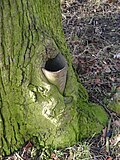 Tree swallowing lamp post
 -
 Tree secondary growth diagram
 -
 Monocot Stem


