Bark beetle: Difference between revisions
CSV import |
CSV import |
||
| Line 29: | Line 29: | ||
[[Category:Pest management]] | [[Category:Pest management]] | ||
{{insect-stub}} | {{insect-stub}} | ||
== Bark beetle == | |||
<gallery> | |||
File:Dendroctonus_ponderosae.jpg|Dendroctonus ponderosae | |||
File:Dead_pines.jpg|Dead pines | |||
File:Bayerischer_wald1.jpg|Bayerischer wald | |||
File:Bark_beetle_gallery.jpg|Bark beetle gallery | |||
File:Bark_beetle_galleries.JPG|Bark beetle galleries | |||
File:Schorskevervraat_op_eik.jpg|Schorskevervraat op eik | |||
File:Elm_bark_beetle_galleries_01.JPG|Elm bark beetle galleries 01 | |||
File:Lapač_kůrovce.JPG|Lapač kůrovce | |||
File:Fichtenstamm_entrindet_-_Detail.jpg|Fichtenstamm entrindet - Detail | |||
</gallery> | |||
Latest revision as of 20:54, 25 February 2025
Bark Beetle
The bark beetle is a member of the subfamily Scolytinae, which is part of the larger family Curculionidae, also known as the weevil family. There are approximately 6,000 species of bark beetles worldwide, with a significant number found in North America.
Biology and Life Cycle[edit]
Bark beetles are small, cylindrical insects that range in size from 1 to 10 millimeters. They are typically brown or black in color. The life cycle of a bark beetle consists of four stages: egg, larva, pupa, and adult. The female bark beetle will bore into the bark of a tree to lay her eggs, creating a gallery. Once the eggs hatch, the larvae will feed on the inner bark of the tree, eventually pupating and emerging as adults.
Ecology and Behavior[edit]
Bark beetles play a crucial role in forest ecosystems. They help to speed up the decomposition process of dead and dying trees, making nutrients available for other organisms. However, in large numbers, they can also cause significant damage to healthy trees. Some species of bark beetles, such as the mountain pine beetle, have been known to cause large-scale tree mortality in North America.
Human Impact and Management[edit]
Bark beetles can have significant impacts on human activities, particularly in forestry and tree farming. They can cause substantial economic losses by killing large numbers of trees. Various methods are used to manage bark beetle populations, including the use of insecticides, pheromone traps, and biological control agents.
See Also[edit]
References[edit]
<references />

Bark beetle[edit]
-
 Dendroctonus ponderosae
 -
 Dead pines
 -
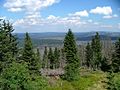 Bayerischer wald
 -
 Bark beetle gallery
 -
 Bark beetle galleries
 -
 Schorskevervraat op eik
 -
 Elm bark beetle galleries 01
 -
 Lapač kůrovce
 -
 Fichtenstamm entrindet - Detail


