Anne Frank: Difference between revisions
CSV import |
CSV import |
||
| Line 23: | Line 23: | ||
[[Category:People from Frankfurt]] | [[Category:People from Frankfurt]] | ||
{{Holocaust-stub}} | {{Holocaust-stub}} | ||
<gallery> | |||
File:Anne_Frank_passport_photo,_May_1942_(cropped).jpg|Anne Frank passport photo, May 1942 | |||
File:AnneFrank1940_crop.jpg|Anne Frank 1940 | |||
File:_AnneFrank1939Polyfoto.jpg|Anne Frank 1939 Polyfoto | |||
File:Frankfurt,_Klinik_Maingau,_Ärztehaus.jpg|Frankfurt, Klinik Maingau, Ärztehaus | |||
File:Anne-frank-geburtshaus-gedenkstele-2011-ffm-027.jpg|Anne Frank Geburtshaus Gedenkstele 2011 | |||
File:Frankfurt,_Ganghoferstraße_24.jpg|Frankfurt, Ganghoferstraße 24 | |||
File:Pastorplatz_1_-_Aachen.JPG|Pastorplatz 1, Aachen | |||
File:Anne_Frank_lacht_naar_de_schoolfotograaf.jpg|Anne Frank laughs at the school photographer | |||
File:AnneFrankHouse_Bookcase.jpg|Anne Frank House Bookcase | |||
</gallery> | |||
Latest revision as of 20:52, 25 February 2025

Anne Frank (12 June 1929 – February or March 1945) was a German-Dutch diarist of Jewish heritage. One of the most discussed Jewish victims of the Holocaust, her wartime diary, The Diary of a Young Girl, was published posthumously and has become one of the world's most famous books, shedding light on the life of a Jewish family hiding from the Nazis in Amsterdam, Netherlands.
Early Life[edit]
Anne Frank was born Annelies Marie Frank in Frankfurt, Germany, to Otto Frank and Edith Frank-Holländer. In 1933, following Adolf Hitler's rise to power and the subsequent persecution of Jews, the Frank family moved to Amsterdam in the hopes of escaping anti-Semitic laws. They lived a normal life until the German occupation of the Netherlands in 1940.
The Secret Annex[edit]
In July 1942, after Margot Frank, Anne's sister, received a call-up notice from the Gestapo, the Frank family went into hiding in concealed rooms behind Otto Frank's business premises. This hiding place was referred to as the "Secret Annex." Along with four other Jewish people, they lived in constant fear of discovery, relying on non-Jewish friends for supplies and support.
The Diary[edit]
During her time in hiding, Anne Frank kept a diary in which she documented her life, thoughts, and feelings. She wrote about the challenges of living in such confined quarters, her aspirations to become a writer, and her insights into human nature. The diary also includes poignant reflections on the persecution of Jews and the horrors of war.
Discovery and Death[edit]
The group in hiding was discovered by the Nazis in August 1944, following a tip-off from an unknown informant. They were arrested and deported to concentration camps. Anne and her sister Margot were eventually transferred to the Bergen-Belsen concentration camp, where they died of typhus in early 1945, just weeks before the camp was liberated.
Posthumous Publication[edit]
After the war, Otto Frank, the sole survivor of the Secret Annex, returned to Amsterdam and found that Anne's diary had been saved by Miep Gies, one of the helpers. Moved by her writings, he arranged for its publication in 1947 under the title The Diary of a Young Girl. It has since been translated into over 70 languages and sold millions of copies worldwide.
Legacy[edit]
Anne Frank's diary has had a significant impact on how the Holocaust is viewed, bringing a personal and human perspective to the atrocities. The Anne Frank House, where the Frank family hid, is now a museum that attracts visitors from around the globe. Anne's story continues to inspire people to fight against discrimination and injustice.

-
 Anne Frank passport photo, May 1942
 -
 Anne Frank 1940
 -
 Anne Frank 1939 Polyfoto
 -
 Frankfurt, Klinik Maingau, Ärztehaus
 -
 Anne Frank Geburtshaus Gedenkstele 2011
 -
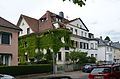 Frankfurt, Ganghoferstraße 24
 -
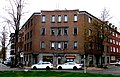 Pastorplatz 1, Aachen
 -
 Anne Frank laughs at the school photographer
 -
 Anne Frank House Bookcase
.jpg)


