List of pollen sources: Difference between revisions
CSV import |
CSV import |
||
| Line 43: | Line 43: | ||
[[Category:Plants]] | [[Category:Plants]] | ||
{{plants-stub}} | {{plants-stub}} | ||
== List of pollen sources == | |||
<gallery> | |||
File:Bee_on_top_of_rata_flower.jpg|Bee on top of rata flower | |||
File:Early_April_Pollen.jpg|Early April Pollen | |||
File:Plumpollen0060.jpg|Plumpollen | |||
File:Ucan-ari1.jpg|Ucan-ari | |||
File:blue2.JPG|Blue | |||
File:may_red_chestnut2.JPG|May red chestnut | |||
File:Bee_on_dandelion.JPG|Bee on dandelion | |||
</gallery> | |||
Latest revision as of 12:03, 25 February 2025
List of Pollen Sources is a comprehensive catalog of various plants, trees, and flowers that produce pollen, a powdery substance consisting of pollen grains which are male microgametophytes of seed plants. Pollen is a crucial component in the reproduction of plants and is also a significant factor in allergic reactions in humans.
Overview[edit]
Pollen is produced by the anther of seed-bearing plants and is disseminated by various means, including wind, water, and animals. The type and quantity of pollen produced by a plant are influenced by its species, environment, and time of year.
Pollen Sources[edit]
Trees[edit]
Many tree species are significant pollen sources. These include:
- Oak: Oak trees are prolific pollen producers and a major cause of hay fever.
- Pine: Pine trees produce large amounts of pollen, which is often visible as a yellow dust.
Flowers[edit]
Flowers are a well-known source of pollen. Some examples include:
- Daisy: Daisies produce pollen that is often collected by bees for honey production.
- Sunflower: Sunflowers are a major pollen source, particularly in agricultural areas.
Grasses[edit]
Grasses are another common source of pollen. These include:
- Ryegrass: Ryegrass pollen is a common allergen.
- Bermuda grass: Bermuda grass produces pollen that is a common cause of hay fever.
Pollen and Allergies[edit]
Pollen is one of the most common causes of allergies. Many people have an adverse immune response when they inhale pollen, leading to allergic rhinitis, also known as hay fever. Symptoms can include sneezing, itchy or watery eyes, and a runny or stuffy nose.
See Also[edit]
This plant related article is a stub. You can help WikiMD by expanding it.
List of pollen sources[edit]
-
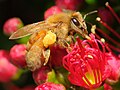 Bee on top of rata flower
 -
Early April Pollen
-
Plumpollen
-
Ucan-ari
-
Blue
-
May red chestnut
-
Bee on dandelion


