Mie goreng: Difference between revisions
CSV import Tags: mobile edit mobile web edit |
CSV import Tags: mobile edit mobile web edit |
||
| Line 28: | Line 28: | ||
{{Indonesia-food-stub}} | {{Indonesia-food-stub}} | ||
{{food-stub}} | {{food-stub}} | ||
<gallery> | |||
File:Mi_Goreng_GM.jpg|Mi Goreng GM | |||
File:Masak_mie_goreng_jawa1.jpg|Masak Mie Goreng Jawa | |||
File:Aceh_fried_noodles.JPG|Aceh Fried Noodles | |||
File:Indomie_Mie_Goreng_Iga_Penyet_1.JPG|Indomie Mie Goreng Iga Penyet | |||
File:Mi_goreng_tek-tek.JPG|Mi Goreng Tek-Tek | |||
File:Mi_goreng.JPG|Mi Goreng | |||
File:Mie_goreng.jpg|Mie Goreng | |||
File:Mie_goreng_kecap.jpg|Mie Goreng Kecap | |||
</gallery> | |||
Latest revision as of 12:02, 25 February 2025
Mie goreng (also spelled mi goreng), which translates to "fried noodles" in English, is a popular traditional dish from Indonesia. It is a flavorful and spicy fried noodle dish common in Indonesia, Malaysia, and Singapore.
History[edit]
The origins of mie goreng can be traced back to China, where the practice of frying noodles began. Chinese immigrants brought this culinary technique to Indonesia, where it was adapted to local tastes and ingredients, resulting in the creation of mie goreng.
Ingredients and Preparation[edit]
Mie goreng is typically made with yellow wheat noodles, which are stir-fried in cooking oil with garlic, onion, and soy sauce, and often includes a mix of vegetables (such as cabbage, chilies, carrots, and bean sprouts), protein (such as chicken, beef, or shrimp), and eggs. Some variations may also include peanut sauce, sambal, or kecap manis (a sweet soy sauce).
Variations[edit]
There are many variations of mie goreng, each with its own unique combination of ingredients. Some of the most popular variations include mie goreng ayam (with chicken), mie goreng sapi (with beef), and mie goreng udang (with shrimp). There is also a vegetarian version, mie goreng sayur, which includes a variety of vegetables but no meat or seafood.
Cultural Significance[edit]
Mie goreng is a staple food in Indonesia and is commonly sold by street vendors, at traditional markets, and in restaurants. It is often consumed as a main dish, but can also be served as a side dish or snack. Mie goreng is also a popular choice for late-night meals due to its quick and easy preparation.
See Also[edit]

-
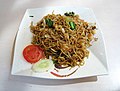 Mi Goreng GM
 -
 Masak Mie Goreng Jawa
 -
 Aceh Fried Noodles
 -
 Indomie Mie Goreng Iga Penyet
 -
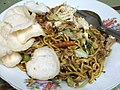 Mi Goreng Tek-Tek
 -
 Mi Goreng
 -
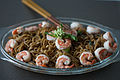 Mie Goreng
 -
 Mie Goreng Kecap


