Reefer ship: Difference between revisions
CSV import |
CSV import |
||
| Line 20: | Line 20: | ||
[[Category:Refrigerated transport]] | [[Category:Refrigerated transport]] | ||
{{transport-stub}} | {{transport-stub}} | ||
<gallery> | |||
File:Salica_Frigo_cropped.jpg|Salica Frigo | |||
File:Lombok_Strait.jpg|Lombok Strait | |||
File:Unloading_frozen_meat_from_'Clan_MacDougall'.jpg|Unloading frozen meat from 'Clan MacDougall' | |||
File:Dole_Honduras_in_San_Diego.jpg|Dole Honduras in San Diego | |||
File:SS_Dunedin_by_Frederick_Tudgay.JPG|SS Dunedin by Frederick Tudgay | |||
File:Loading_"Clan_McDougall"_with_frozen_meat_for_England.jpg|Loading "Clan McDougall" with frozen meat for England | |||
File:USS_Mizar_(AF-12)_departing_Mare_Island_Naval_Shipyard,_California_(USA),_8_February_1946.jpg|USS Mizar (AF-12) departing Mare Island Naval Shipyard, California, 8 February 1946 | |||
File:BALTIC_JASMINE.jpg|BALTIC JASMINE | |||
</gallery> | |||
Latest revision as of 11:48, 25 February 2025

A Reefer ship is a type of ship specifically designed for the transportation of perishable goods at cold temperatures. It plays a crucial role in the global supply chain, enabling the international trade of food products such as fruit, vegetables, meat, and seafood, as well as non-food perishables like flowers. Reefer ships are equipped with onboard refrigeration systems that maintain precise temperature and humidity levels, ensuring that goods arrive at their destination in optimal condition.
History[edit]
The development of reefer ships can be traced back to the 19th century, with advancements in marine refrigeration technology enabling longer distance transport of perishable goods. Initially, ice was used to cool cargoes, but this method was gradually replaced by mechanical refrigeration systems. The introduction of these ships revolutionized the food industry, making it possible to supply fresh produce all year round, regardless of seasonal limitations.
Design and Features[edit]
Reefer ships are distinguished by their sophisticated refrigeration equipment, which can be adjusted to suit the specific requirements of the cargo. The ships are divided into insulated compartments, allowing different types of goods to be stored at their ideal temperatures and humidity levels. Modern reefer ships also incorporate advanced ventilation systems to remove ethylene gas, which fruits emit as they ripen, thereby slowing down the ripening process and extending shelf life.
Operation[edit]
Operating a reefer ship requires specialized knowledge and skills. The crew must closely monitor the refrigeration systems and environmental conditions within the cargo holds. This includes regular checks of temperature and humidity levels, as well as ensuring the proper functioning of the ventilation and cooling systems. The precise management of these factors is critical to prevent spoilage and ensure the quality of the perishable goods upon arrival.
Challenges[edit]
The reefer shipping industry faces several challenges, including high operational costs due to the energy consumption of refrigeration systems and the need for specialized maintenance. Additionally, the industry must navigate stringent regulations related to environmental protection and food safety. The increasing demand for fresh produce year-round also puts pressure on reefer ship operators to expand their fleets and enhance their technological capabilities.
Future Trends[edit]
The future of reefer shipping is likely to be shaped by technological advancements and sustainability efforts. Innovations in refrigeration technology, such as the use of renewable energy sources and more efficient cooling systems, are expected to reduce operational costs and environmental impact. Additionally, the integration of digital technology and Internet of Things (IoT) devices is set to improve the monitoring and management of cargo conditions, further ensuring the quality and safety of perishable goods during transport.

-
 Salica Frigo
 -
 Lombok Strait
 -
 Unloading frozen meat from 'Clan MacDougall'
 -
 Dole Honduras in San Diego
 -
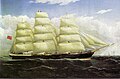 SS Dunedin by Frederick Tudgay
 -
 Loading "Clan McDougall" with frozen meat for England
 -
 USS Mizar (AF-12) departing Mare Island Naval Shipyard, California, 8 February 1946
 -
 BALTIC JASMINE


_departing_Mare_Island_Naval_Shipyard,_California_(USA),_8_February_1946.jpg)

