Kenkey: Difference between revisions
CSV import |
CSV import |
||
| Line 36: | Line 36: | ||
File:Fante_kenkey.jpg | File:Fante_kenkey.jpg | ||
File:Fante_kenkey_2.jpg | File:Fante_kenkey_2.jpg | ||
</gallery> | |||
== Kenkey == | |||
<gallery> | |||
File:Kenkey_and_ground_pepper_with_sardine.jpg|Kenkey and ground pepper with sardine | |||
File:Fante_kenkey.jpg|Fante kenkey | |||
File:Fante_kenkey_2.jpg|Fante kenkey 2 | |||
</gallery> | </gallery> | ||
Revision as of 11:47, 25 February 2025
Kenkey is a staple food common in many parts of West Africa. It is a type of fermented corn dough and is usually served with a soup, stew, or sauce.
History
The history of Kenkey dates back to the pre-colonial era of West Africa. It is believed to have originated from the Ga people of Ghana, but it has since spread to other parts of the region.
Preparation
Kenkey is made from corn dough that has been allowed to ferment over a period of days. The dough is then partially cooked, wrapped in corn husks or plantain leaves, and then steamed until fully cooked. The fermentation process gives Kenkey a slightly sour taste, similar to that of sourdough bread.
Varieties
There are several varieties of Kenkey, including Ga Kenkey and Fante Kenkey, named after the Ga and Fante people of Ghana. The main difference between these varieties is the type of corn used and the length of fermentation.
Nutritional Value
Kenkey is a good source of carbohydrates, providing energy for the body. It also contains some protein, fiber, and a small amount of vitamins and minerals.
Cultural Significance
Kenkey plays a significant role in the culture and traditions of the people of Ghana. It is often served at festivals and other special occasions. In addition, it is a common street food in many parts of the country.
See Also


Kenkey


Kenkey
-
 Kenkey and ground pepper with sardine
 -
 Fante kenkey
 -
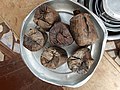 Fante kenkey 2

