Heliciculture: Difference between revisions
CSV import Tags: mobile edit mobile web edit |
CSV import |
||
| Line 30: | Line 30: | ||
[[Category:Mollusca]] | [[Category:Mollusca]] | ||
{{food-stub}} | {{food-stub}} | ||
==Heliciculture== | |||
<gallery> | |||
File:Eyragues-l-Escargot-des-Alpilles-5738.jpg|Eyragues l'Escargot des Alpilles | |||
File:Snails-Italy.jpg|Snails Italy | |||
File:Cepaea_nemoralis_pair_banded_shells.jpg|Cepaea nemoralis pair banded shells | |||
File:Achatina_fulica_Thailand.jpg|Achatina fulica Thailand | |||
</gallery> | |||
Latest revision as of 11:46, 25 February 2025
Heliciculture, also known as snail farming, is the process of raising land snails specifically for human use. It can be for culinary purposes, but also for the snails' slime which is used in cosmetics, or their shells in decorative items.
History[edit]
The practice of heliciculture dates back to the Roman Empire, where snails were fattened in cochlearia, or snail gardens. The Romans, as well as people in the Middle Ages, consumed snails during Lent, as they were not considered meat.
Species[edit]
The most commonly farmed species in modern heliciculture are the Helix aspersa and the Helix pomatia, also known as the Petit Gris and the Escargot de Bourgogne respectively. These species are preferred due to their size, growth rate, and taste.
Farming Methods[edit]
Heliciculture can be conducted in a controlled environment, such as a greenhouse, where temperature, humidity, and light can be regulated. Snails can also be farmed outdoors, in specially designed pens.
Market[edit]
The global market for snails is significant, with Europe being the largest consumer. France, Italy, and Spain are the largest importers, while countries like Greece, Turkey, and Morocco are the largest exporters.
Challenges[edit]
Despite its potential profitability, heliciculture faces several challenges. These include diseases, predation, and strict regulations regarding the transportation of live snails.
See Also[edit]

Heliciculture[edit]
-
 Eyragues l'Escargot des Alpilles
 -
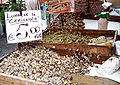 Snails Italy
 -
 Cepaea nemoralis pair banded shells
 -
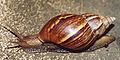 Achatina fulica Thailand


