Lacticaseibacillus casei: Difference between revisions
CSV import Tags: mobile edit mobile web edit |
CSV import Tags: mobile edit mobile web edit |
||
| Line 32: | Line 32: | ||
<gallery> | <gallery> | ||
File:Lactobacilos_Casei_Shirota.jpg | File:Lactobacilos_Casei_Shirota.jpg | ||
</gallery> | |||
<gallery> | |||
File:Lactobacillus_casei_1.jpg|Lactobacillus casei 1 | |||
File:Lactobacilos_Casei_Shirota.jpg|Lactobacilos Casei Shirota | |||
</gallery> | </gallery> | ||
Latest revision as of 11:34, 25 February 2025
Lacticaseibacillus casei is a species of Gram-positive, rod-shaped bacteria that is used extensively in the fermentation of dairy products. It is a member of the Lacticaseibacillus genus, which is part of the larger Lactobacillaceae family.
Taxonomy[edit]
The species was first described in 1933 by Minoru Shirota, who isolated it from a sample of fermented milk. It was originally classified as Lactobacillus casei, but was reclassified as Lacticaseibacillus casei in 2020 following a major revision of the Lactobacillus genus.
Characteristics[edit]
Lacticaseibacillus casei is a facultative anaerobe, meaning it can grow in both the presence and absence of oxygen. It is catalase-negative and does not produce spores. The bacteria are rod-shaped and typically arranged in short chains.
Uses[edit]
Lacticaseibacillus casei is used in the production of a variety of fermented dairy products, including yogurt, cheese, and kefir. It is also used in the production of probiotic supplements, due to its potential health benefits.
Health Benefits[edit]
Research has suggested that Lacticaseibacillus casei may have a number of health benefits. These include improving digestive health, boosting the immune system, and potentially helping to prevent certain types of cancer. However, more research is needed to fully understand these potential benefits.
See Also[edit]
References[edit]
<references />


-
 Lactobacillus casei 1
 -
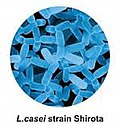 Lactobacilos Casei Shirota

