Moai: Difference between revisions
CSV import |
CSV import Tags: mobile edit mobile web edit |
||
| Line 30: | Line 30: | ||
[[Category:Outdoor sculptures]] | [[Category:Outdoor sculptures]] | ||
{{Archaeology-stub}} | {{Archaeology-stub}} | ||
<gallery> | |||
File:AhuTongariki.JPG|Ahu Tongariki | |||
File:Moai_Rano_raraku.jpg|Moai Rano Raraku | |||
File:Cantera_de_moais.jpg|Cantera de moais | |||
File:Ahu_Tahai.jpg|Ahu Tahai | |||
File:View_of_the_back_of_a_moai_with_petroglyph_carvings,_partially_excavated;_a_South_American_man_is_sitting_on_the_ground,_with_one_bare_foot_on_the_shoulder_of_the_sculpture;_Rano_Raraku,_Oc,G.T.1465,_Mana_Expedition_to_Easter_Island,_British_Museum.jpg|View of the back of a moai with petroglyph carvings | |||
File:Easter_Island_map-en.svg|Easter Island map | |||
File:Isla_de_Pascua,_Chile._03.jpg|Isla de Pascua, Chile | |||
File:Ahu-Akivi-1.JPG|Ahu Akivi | |||
</gallery> | |||
Latest revision as of 11:32, 25 February 2025
Moai are monolithic human figures carved by the Rapa Nui people on the Easter Island in eastern Polynesia between the years 1250 and 1500. Nearly half are still at Rano Raraku, the main moai quarry, but hundreds were transported from there and set on stone platforms called ahu around the island's perimeter. Almost all moai have overly large heads three-eighths the size of the whole statue. The moai are chiefly the living faces (aringa ora) of deified ancestors (aringa ora ata tepuna).
History[edit]
The production and transportation of the 887 statues are considered remarkable creative and physical feats. The tallest moai erected, called Paro, was almost 10 metres (33 ft) high and weighed 82 tons; the heaviest erected was a shorter but squatter moai at Ahu Tongariki, weighing 86 tons; and one unfinished sculpture, if completed, would have been approximately 21 metres (69 ft) tall with a weight of about 270 tons.
Construction and Transportation[edit]
The moai were carved in relatively flat planes, the faces bearing proud but enigmatic expressions. The human figures would be outlined in the rock wall first, then chiseled out with pointed tools, their torsos would be detached from the rock wall, then finally they would be released from the quarry to be transported to the ahu where they would be erected.
Cultural Significance[edit]
The moai statues are central to the Rapa Nui people's history and culture. They represent the ancestors who are believed to bestow mana (blessings) upon their descendants. They were also important in delineating territories among the six clans of Rapa Nui people.
Preservation and Restoration[edit]
Many of the moai statues have been restored and re-erected on their ahu, particularly by the efforts of the Easter Island Statue Project and other international archaeology teams.
See Also[edit]

-
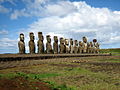 Ahu Tongariki
 -
 Moai Rano Raraku
 -
 Cantera de moais
 -
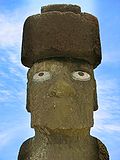 Ahu Tahai
 -
 View of the back of a moai with petroglyph carvings
 -
 Easter Island map
 -
 Isla de Pascua, Chile
 -
 Ahu Akivi


