Sarcodon imbricatus: Difference between revisions
CSV import |
CSV import |
||
| Line 36: | Line 36: | ||
* [http://www.rogersmushrooms.com/gallery/DisplayBlock~bid~6439.asp Sarcodon imbricatus] at Roger's Mushrooms | * [http://www.rogersmushrooms.com/gallery/DisplayBlock~bid~6439.asp Sarcodon imbricatus] at Roger's Mushrooms | ||
{{dictionary-stub1}} | {{dictionary-stub1}} | ||
<gallery> | |||
File:Habichtspilz-Sarcodon-imbricatus.jpg|Habichtspilz Sarcodon imbricatus | |||
File:Neungi-cha.jpg|Neungi cha | |||
</gallery> | |||
Latest revision as of 11:29, 25 February 2025
Sarcodon imbricatus[edit]
Sarcodon imbricatus, commonly known as the shingled hedgehog or scaly hedgehog, is a species of tooth fungus in the family Bankeraceae. It is found in North America and Europe, where it grows on the ground in coniferous forests, forming mycorrhizal associations with the trees.
Taxonomy[edit]
The species was first described scientifically by Elias Magnus Fries in 1821. The generic name Sarcodon is derived from the Greek words sarkos (flesh) and odous (tooth), while the specific epithet imbricatus refers to the shingled or overlapping pattern of the scales on the cap.
Description[edit]
The fruit body of Sarcodon imbricatus is large and robust, with a cap that can reach up to 30 cm (12 in) in diameter. The cap is initially convex, but flattens out with age, and is covered with large, dark brown to black scales. The underside of the cap features small, downward-pointing spines or "teeth" instead of the gills typically found in other mushroom species. The flesh is white and has a bitter taste.
Habitat and distribution[edit]
Sarcodon imbricatus is widely distributed in the Northern Hemisphere, particularly in coniferous forests in North America and Europe. It forms mycorrhizal associations with various species of conifers, including spruce, pine, and fir.
Edibility[edit]
While Sarcodon imbricatus is technically edible, its bitter taste makes it unpalatable to most. Some sources suggest that it can be made more palatable by thorough cooking or pickling, but it is generally not recommended for consumption.
Medicinal uses[edit]
Some studies suggest that Sarcodon imbricatus may have medicinal properties, including anti-inflammatory and antitumor effects. However, more research is needed to confirm these potential benefits.
See also[edit]
References[edit]
External links[edit]
- Sarcodon imbricatus at MushroomExpert.com
- Sarcodon imbricatus at Roger's Mushrooms

-
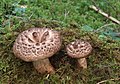 Habichtspilz Sarcodon imbricatus
 -
 Neungi cha


